

Most people can name a handful of major world languages, but very few can guess how many truly exist. Ask around and you will hear guesses like 50, 200 or maybe a few hundred. The real number is far higher. According to Ethnologue, there are about 7,159 living languages spoken in the world today.
While billions rely on global languages such as English, Mandarin or Spanish, thousands of others are spoken by small communities, sometimes by only a few families.
In this article, we will explore where these languages are found, why so many exist and what is happening to them in the twenty-first century.
How Many Languages Exist Today?

The most reliable global estimate comes from Ethnologue, which tracks living languages across the world. According to its latest data, there are about 7,159 living languages spoken today. This figure changes as new research is conducted, as communities shift and as languages evolve or disappear.
Several points explain why this number is higher than most people expect:
- The world’s twenty largest languages are spoken by more than 3.7 billion people, while thousands of others are spoken by communities of under 10,000.
- About 44 percent of all languages are considered endangered.
- Many languages have never been standardized or widely documented.
- Some speech forms exist in a grey area between “language” and “dialect,” and classifications vary between linguistic authorities.
Why does the number change
Language counts are not fixed. Linguists update them based on:
- recognition of previously undocumented languages
- reclassification of dialects
- Languages shifting from vulnerable to extinct
- new census information from remote regions
Global snapshot
| Category | Number | Notes |
| Total living languages (Ethnologue) | ~7,159 | Widely referenced global figure |
| Endangered languages | ~3,193 | About 44 percent of all living languages |
| Languages with more than 50 million speakers | Fewer than 30 | Represents a small part of global diversity |
| Languages with under 1,000 speakers | Several thousand | High risk of extinction |
As we can see from these figures, global linguistic diversity extends far beyond the major languages used in international communication. These counts cover only documented living languages, which means additional variations may exist in regions that have not been fully studied.
Where Are the World’s Languages Located?
Some regions contain hundreds of small languages within a relatively small geographic area, while others have large populations but far fewer languages. Understanding this distribution helps clarify why global communication needs differ greatly from region to region.
Global Distribution Overview
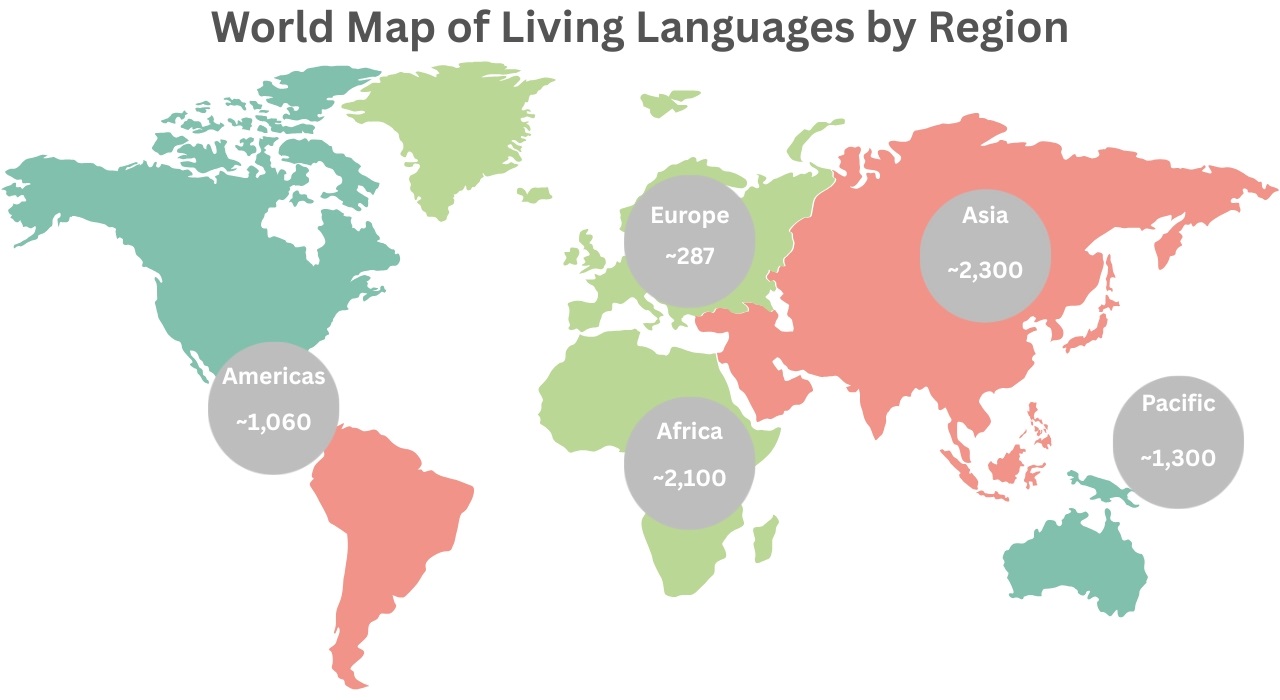
According to Ethnologue, the world’s living languages are concentrated in five major regions:
| Region | Number of Living Languages | Share of Global Total | Notable Facts |
| Asia | ~2,300 | ~32% | Largest number of languages overall |
| Africa | ~2,100 | ~30% | Strong ethnic and cultural diversity |
| Pacific | ~1,300 | ~18% | Highest linguistic density relative to population |
| Americas | ~1,060 | ~15% | Many Indigenous languages with declining speaker populations |
| Europe | ~287 | ~4% | Fewest languages but strong global influence historically |
Asia
Asia contains the highest number of living languages in the world due to vast populations, varied migration histories and long-standing cultural separation between communities.
While major languages such as Mandarin, Hindi, Arabic and Japanese dominate numerically, thousands of smaller regional languages continue in parallel. The region’s diversity is so great that the island of New Guinea alone contains more languages than the entire Asian mainland.
Africa
Africa is one of the most linguistically diverse regions. Countries such as Nigeria have more than 500 languages, many of which belong to entirely different language families.
Geographic barriers such as deserts, forests and mountain ranges helped isolate communities and preserve linguistic differences. Some African languages, including Xhosa and Khoekhoe, use click consonants as core sounds, a feature rarely found elsewhere.
Pacific Region
The Pacific region has exceptional linguistic density despite its relatively small population. Papua New Guinea accounts for more than 800 languages, the highest number within any single country.
Many of these languages developed independently because island separation limited contact between communities. Some Pacific languages contain unusually large phoneme inventories, making them among the most complex in the world from a sound system perspective.
Americas
The Americas were home to thousands of Indigenous languages before European colonization. Many survive today, though often with smaller speaker populations.
Linguistic diversity remains strong in areas such as the Andes, the Amazon and Mesoamerica, where Indigenous communities have maintained cultural continuity. Quechua, spoken across the Andes, is the most widely spoken Indigenous language in the region.
Europe
Europe contains the smallest number of living languages compared with other continents, yet its languages have shaped global communication through historical trade and colonization.
Most languages belong to the Indo-European family, with Romance, Germanic and Slavic groups being the most widespread. Europe also has several officially multilingual states such as Switzerland, Belgium and Luxembourg where multiple national languages operate side by side.
How Many Languages Are Endangered?
A significant portion of the world’s languages is at risk of disappearing. While more than 7,000 languages are spoken today, almost half have shrinking speaker populations and limited institutional support.
Current Estimates
According to UNESCO data:
- About 3,000+ languages are classified as endangered
- Roughly 40 to 45 percent of all living languages face a real risk of extinction
- Many endangered languages have fewer than 1,000 speakers, and some have only a handful remaining
Where Endangered Languages Are Concentrated
Endangerment is not distributed evenly across the globe. Some countries contain large clusters of vulnerable languages.
| Country / Region | Number of Endangered Languages | Notes |
| Indonesia | ~425 | High internal diversity and isolated communities |
| Papua New Guinea | ~312 | Many local languages spoken by small groups |
| Australia | ~190 | Majority of Indigenous languages endangered |
| United States | ~180 | Many Native American languages at risk |
| Brazil | ~170 | Amazonian languages facing rapid decline |
Key Reasons Languages Become Endangered
Endangerment is typically caused by multiple factors acting at the same time:
- Language shift: communities adopt a dominant national or regional language
- Urbanization: younger generations move to cities and stop using their heritage language
- Lack of transmission: parents do not pass the language to children
- Limited institutional support: schools, media and public services operate in dominant languages
- Stigma and discrimination: some languages lose status, causing speakers to abandon them
- Historical displacement: colonization and forced assimilation have long-term effects
Why Do Languages Disappear?
Languages rarely vanish overnight. Most disappear gradually as social, economic and political pressures push communities toward more dominant languages.
The following factors explain why thousands of languages are currently at risk.
1. Pressure to Use Dominant National or Regional Languages
When education, healthcare, legal systems and employment are available only in a major language, communities often shift to it for practical survival. UNESCO’s Atlas of the World’s Languages in Danger highlights this as one of the most common causes of language loss.
2. Urbanization and Migration

Younger speakers frequently leave rural areas for cities where minority languages are not used. Over time, daily communication shifts toward widely spoken languages, especially in multilingual urban centers.
3. Intermarriage and Multilingual Families
In families where parents speak different heritage languages, children often adopt only one language, typically the majority or global language that provides broader opportunities.
4. Stigma and Historical Suppression
Many Indigenous and minority languages were suppressed by colonial administrations or national governments. This created long-term social stigma. Communities may stop transmitting the language to avoid discrimination.
Examples documented by UNESCO and various linguistic researchers include:
- Indigenous languages in North America were historically suppressed in residential schools, where children were prohibited from using their native languages. This history contributed significantly to the decline of many Indigenous languages across the region.
- Ainu in Japan have historically been marginalized, leading to generational language loss
- Aboriginal Australian languages affected by state assimilation policies
5. Globalization and Media Influence

Access to global media reinforces dominant languages. Children often grow up consuming content in English, Spanish, Mandarin or other major languages, while local languages lack comparable presence in television, online platforms or education.
6. Lack of Institutional Support
Without school programs, written materials, digital resources or community initiatives, smaller languages struggle to survive. Once children stop learning the language, extinction usually follows within one or two generations.
These factors help explain why many languages decline rapidly once daily transmission is interrupted. For a translation agency like ours, this context reinforces the importance of working precisely with community languages and ensuring that communication reflects the realities of the groups who use them.
How Many Languages Have Gone Extinct?
While exact numbers are difficult to determine due to incomplete historical records, modern linguistic databases provide clear evidence of long-term decline.
A widely referenced academic source, the Catalogue of Endangered Languages (ELCat), lists more than 570 languages that are now classified as extinct. These are languages that no longer have living native speakers and cannot be used for communication within any community.
Several factors make this number difficult to pinpoint with complete accuracy:
- Many extinct languages were never written down
- Some disappeared before modern linguistic research existed
- Early explorers and colonial administrations documented languages inconsistently
- Oral traditions did not always survive long enough for formal study
Despite these challenges, the available data shows a consistent pattern. For centuries, languages have vanished due to shifts in population, political pressure, migration and assimilation. This has created permanent gaps in the world’s cultural record.
The number of extinct languages highlights how fragile linguistic heritage can be. It also shows how quickly irreplaceable knowledge can be lost when a language no longer has active speakers, which is why accurate work with smaller and vulnerable languages remains essential.
The Most Spoken Languages in the World Today
While thousands of languages are spoken globally, a small group accounts for a significant share of the world’s population. These languages dominate international business, technology, education and media, which is why organizations frequently request translation support in them.
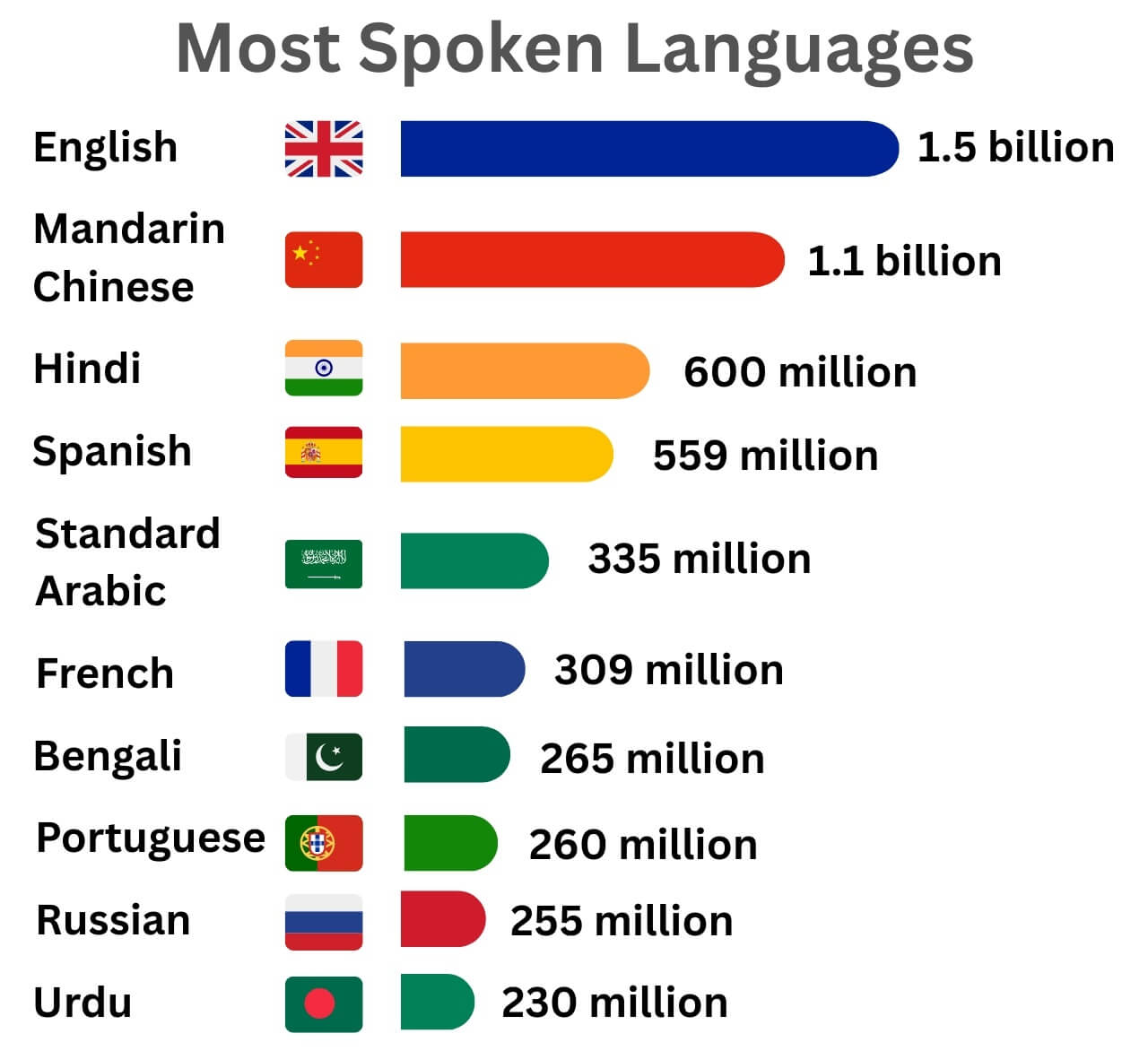
The ranking varies slightly depending on whether total speakers or native speakers are counted. The figures below reflect total speakers, including first and second language use, based on consolidated data from sources such as UNESCO, the World Population Review and global linguistic surveys.
Top 10 Most Spoken Languages (Total Speakers)
| Rank | Language | Approximate Total Speakers |
| 1 | English | 1.5 billion |
| 2 | Mandarin Chinese | 1.1 billion |
| 3 | Hindi | 600 million |
| 4 | Spanish | 559 million |
| 5 | Standard Arabic | 335 million |
| 6 | French | 309 million |
| 7 | Bengali | 265 million |
| 8 | Portuguese | 260 million |
| 9 | Russian | 255 million |
| 10 | Urdu | 230 million |
These languages shape global communication, yet they represent only a fraction of the linguistic diversity found worldwide.
Most translation requests focus on this group because they act as lingua francas in international institutions, digital platforms, and global commerce.
Conclusion
The world is home to thousands of living languages, each shaped by history, culture and community.
While only a small number dominate global communication, most are spoken by small groups whose linguistic traditions remain vital to their identity. For organizations that operate internationally, this diversity means that professional translation is not only a practical need but also a responsibility.
Accurate language support helps preserve clarity, respect cultural differences and ensure that people are understood in the language that represents them best.