

Spend a little time in Miami and one thing becomes obvious very quickly: Spanish is everywhere.
Walk into a café, step into a grocery store, listen to conversations on the street, or call a local business, and there is a strong chance the first language you hear will be Spanish.
The numbers help explain why. In Miami-Dade County, about 67% of residents age five and older speak Spanish at home, according to recent Census data. With a population of roughly 2.8 million, close to two million residents live in Spanish-speaking households. In other words, Spanish is not just common in Miami. It shapes everyday life for a huge part of the local population.
This did not happen overnight. For decades, Miami has attracted immigrants from Cuba, Venezuela, Colombia, Nicaragua, the Dominican Republic, and many other parts of Latin America and the Caribbean. As these communities grew, Spanish naturally became part of daily communication in neighborhoods, workplaces, schools, and media.
Because of that history, Miami feels different from most large cities in the United States. English and Spanish coexist in everyday life. People switch between the two languages all the time, and in many parts of the city, Spanish is just as useful as English for work, services, and business.
Understanding how many people speak Spanish in Miami helps explain a lot about the city itself. Language, immigration, culture, and business are closely connected here, and Spanish sits right in the middle of that story.
Why is Spanish So Widely Spoken In Miami?
Over the last six decades, Miami developed into one of the most important gateways between the United States and Latin America.
As more immigrants settled in South Florida, Spanish naturally became part of everyday life in neighborhoods, workplaces, media, and local institutions.
Several key factors explain why Spanish plays such a central role in the city today.
Immigration from Latin America and the Caribbean
Immigration is the main reason Spanish became so widespread in Miami.
Large migration waves began in the early 1960s when Cuban families moved to South Florida after the Cuban Revolution.
Many of them settled in neighborhoods that later became cultural centers of the Cuban American community, such as Little Havana.
Later decades brought new immigration from other parts of Latin America.
Communities from countries such as Venezuela, Colombia, Nicaragua, Argentina, Peru, and the Dominican Republic grew steadily and helped reinforce Spanish as a dominant language in the region.
A Majority Hispanic population
Miami-Dade County has one of the largest Hispanic populations in the United States.
Current demographic estimates show:
- About 70% of Miami-Dade residents identify as Hispanic or Latino
- More than 54% of residents were born outside the United States
Spanish in Media, Business, and Public Services
Another important reason Spanish remains so visible in Miami is the presence of Spanish-language media and business infrastructure.
Miami is home to major Spanish-language television networks, radio stations, newspapers, and digital media outlets that serve audiences throughout the United States and Latin America.
Local businesses also adapt to the language preferences of residents. Many companies provide customer service in both English and Spanish, and bilingual signage is common in stores, restaurants, banks, and transportation hubs.
Public institutions follow the same pattern. Government agencies, hospitals, schools, and community organizations frequently offer information in Spanish so residents can access services more easily.
In Local Government And Public Services
Language access is a practical issue in Miami, not just a cultural one. With such a large share of residents speaking Spanish at home, many public services operate in both English and Spanish so people can understand essential information without barriers.
Residents regularly encounter Spanish when interacting with local institutions. County offices, healthcare providers, and community organizations publish notices, service guides, and assistance programs in both languages.
In Schools And Education

Schools offer another clear window into the Miami language landscape. Many students arrive in classrooms already speaking Spanish at home, while English becomes the primary language of instruction.
Miami-Dade County Public Schools serves a highly international population and ranks among the largest school districts in the United States.
Families from Cuba, Venezuela, Colombia, Nicaragua, the Dominican Republic, and many other countries form a large part of the district community.
Because of that diversity, communication between schools and parents often happens in both English and Spanish. School notices, parent meetings, and administrative materials are commonly available in Spanish so families can stay informed about their children’s education.
Spanish In Everyday Life In Miami
Statistics explain part of the story, but daily life in Miami shows the language landscape much more clearly. Spanish appears in ordinary interactions throughout the city.
Conversations at cafés, local markets, small businesses, construction sites, and customer service counters often begin in Spanish without hesitation.
Neighborhoods Where Spanish Shapes Daily Life
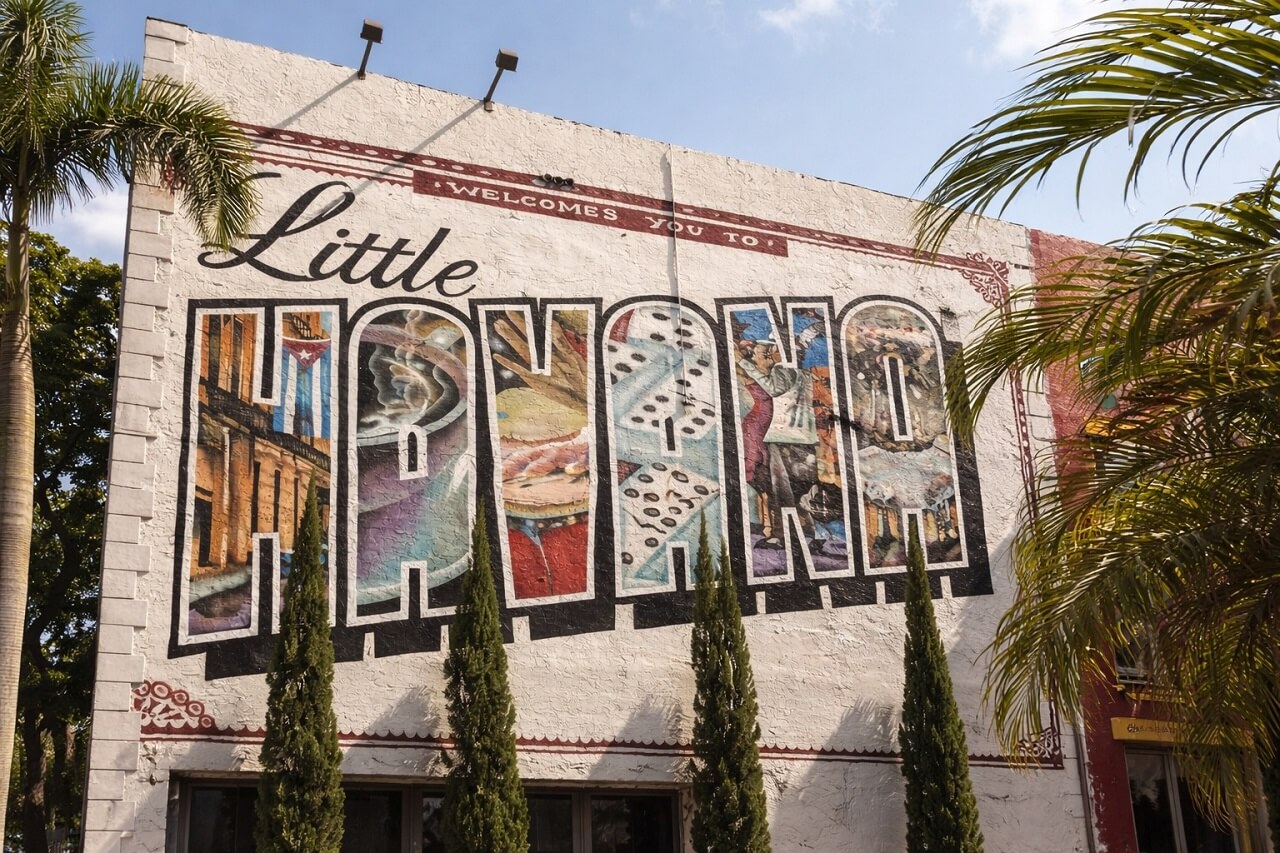
Several areas of Miami illustrate how deeply Spanish is woven into the social fabric of the city.
- Little Havana remains one of the most recognizable centers of Spanish-speaking culture in the United States. Cuban restaurants, bakeries, music venues, and cultural institutions keep Spanish visible in street life and local commerce.
- Doral has grown rapidly in recent years and now hosts a large Venezuelan community. Spanish dominates in many restaurants, business offices, and residential neighborhoods.
- Hialeah, one of the largest cities in Miami-Dade County, has a population where Spanish is widely used in both public and private settings. In many parts of the city, Spanish serves as the first language for everyday interaction.
Other neighborhoods, such as Westchester, Kendall, and Sweetwater, also maintain strong Spanish-speaking populations shaped by immigration from Latin America.
Spanish In Workplaces And Local Businesses

The language also plays a practical role in the local economy. In industries that rely heavily on customer interaction, Spanish communication often helps businesses connect with a larger share of residents.
Several sectors illustrate this clearly:
- hospitality and tourism
- healthcare and clinics
- retail and customer service
- construction and home services
- transportation and logistics
Workers in these industries frequently communicate with coworkers and customers in Spanish during the workday.
Bilingual employees often become valuable bridges between Spanish-speaking clients and English-speaking organizations.
Restaurants, healthcare providers, construction companies, banks, logistics firms, and retail stores often interact with Spanish-speaking customers or workers throughout the day. Clear bilingual communication can prevent misunderstandings and improve customer service.
Many companies operating in South Florida therefore adapt their communication to reflect the local language environment. Common examples include:
- bilingual customer support
- Spanish versions of websites and mobile apps
- translated contracts and legal documents
- multilingual marketing materials
- Spanish-speaking staff in frontline roles
For businesses expanding into Miami, language planning becomes part of a normal market strategy.
Hiring bilingual employees or providing Spanish translations helps companies communicate more clearly with residents and build stronger relationships with local communities.
Spanish Speakers In Miami Compared To Other U.S. Cities
Spanish is widely spoken in many American cities, especially those with large Hispanic populations. Still, the concentration of Spanish speakers in Miami remains unusual even among major metropolitan areas.
Most large cities in the United States have strong Spanish-speaking communities, but they rarely reach the same share of daily language use seen in South Florida.
Cities such as Los Angeles, Houston, New York, and Chicago all have millions of residents and large Latino populations.
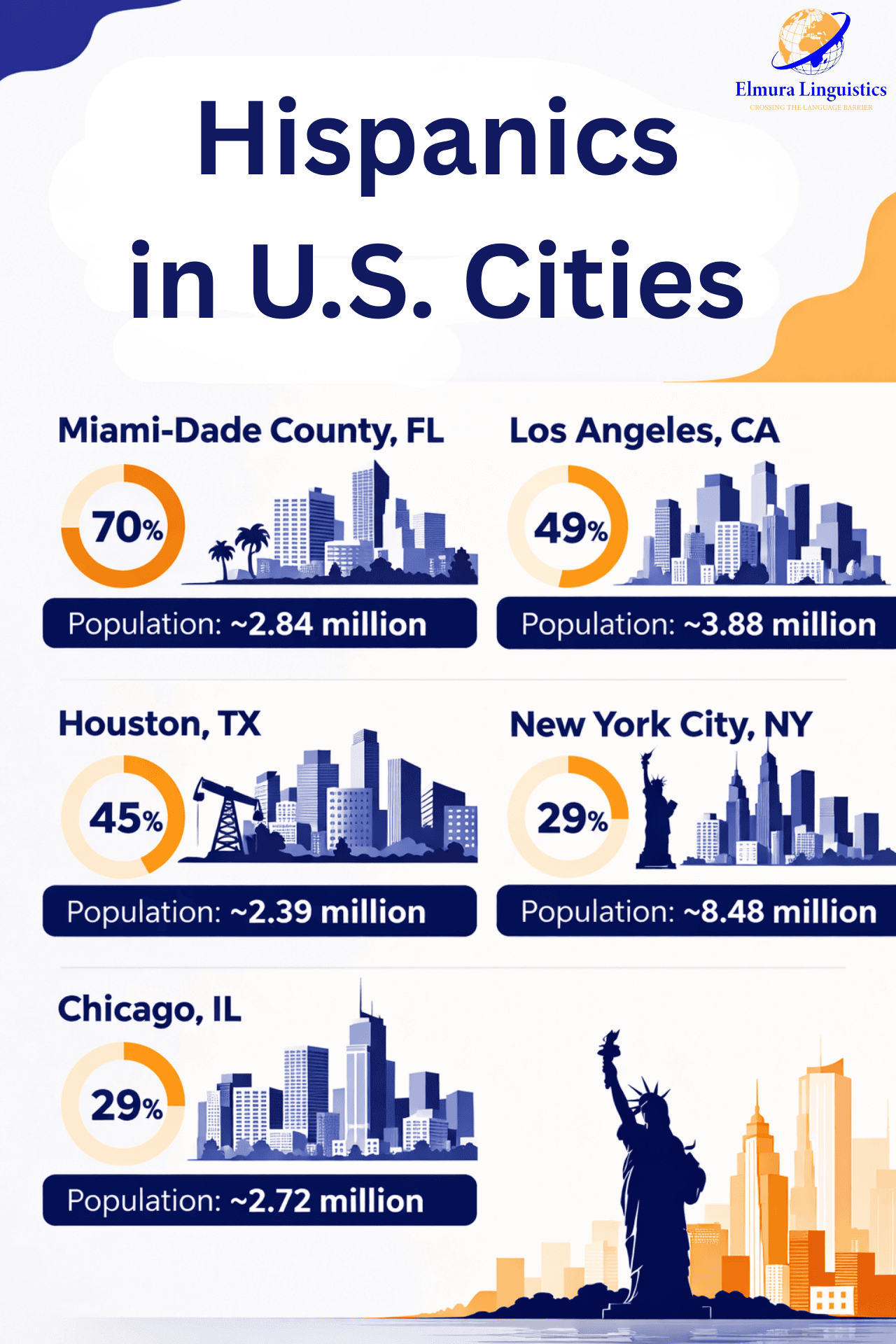
Even in those places, Spanish speakers typically represent a much smaller portion of the population.
| City | Population | Hispanic or Latino Share | Estimated Spanish Spoken at Home |
| Miami-Dade County, FL | ~2.84 million | ~70% | ~67% |
| Los Angeles, CA | ~3.88 million | ~49% | ~38–40% |
| Houston, TX | ~2.39 million | ~45% | ~37% |
| New York City, NY | ~8.48 million | ~29% | ~24–25% |
| Chicago, IL | ~2.72 million | ~29% | ~22–24% |
Several long-term factors explain why Miami stands out in this comparison.
First, Miami-Dade County has one of the highest Hispanic population shares in the United States. In many other cities, Hispanic communities represent a large minority. In Miami-Dade, they represent the majority.
Second, Miami has maintained strong immigration ties with Latin America for decades. Cuban migration beginning in the 1960s played a major role in shaping the city, followed by continued arrivals from Venezuela, Colombia, Nicaragua, Argentina, Peru, and the Dominican Republic.
Third, Spanish functions as a working language in many sectors of the local economy. Businesses, healthcare providers, service industries, and media outlets regularly communicate in Spanish alongside English.
Because of these factors, Miami developed a linguistic environment that looks different from most American cities.
Conclusion
Miami has one of the highest concentrations of Spanish speakers in the United States. A large share of residents in Miami-Dade County speak Spanish at home, and Hispanic communities make up the majority of the local population.
Over several decades, immigration from Latin America and the Caribbean helped establish Spanish as a widely used language in households, workplaces, media, and public services.
Businesses, healthcare providers, schools, and government agencies frequently communicate in both English and Spanish in order to serve local residents effectively. Spanish also appears regularly in customer service, marketing, and day to day workplace interaction.