

Atlanta is one of the fastest-growing metropolitan areas in the United States and one of the most linguistically diverse cities in the Southeast. As immigration, international business, and global education expand across the region, the number of languages spoken in homes and communities continues to increase.
According to the U.S. Census Bureau’s American Community Survey, about 15–16% of Georgia residents speak a language other than English at home. The Atlanta metropolitan area reflects this diversity, with large communities representing languages from Latin America, Asia, Africa, and Europe.
The following data highlights the most common languages spoken in Atlanta and the surrounding metropolitan area based on recent population estimates.
Top Languages Spoken in the Atlanta Metropolitan Area
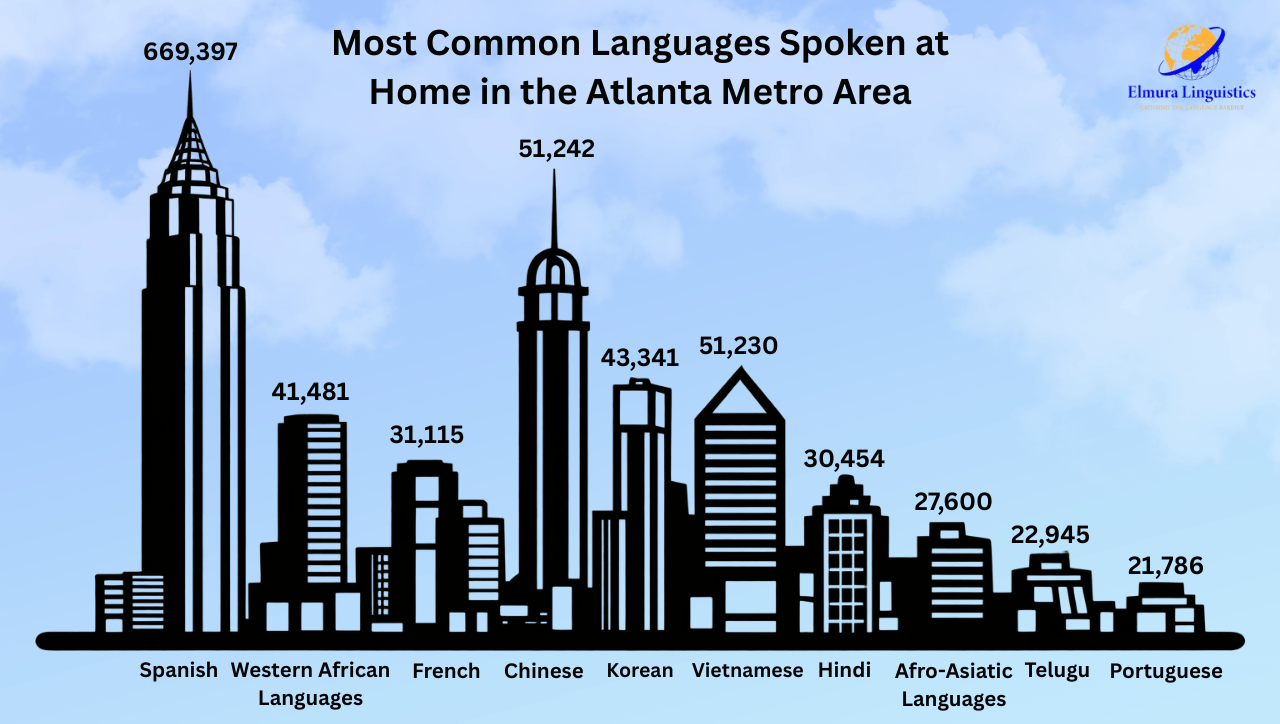
The Atlanta metropolitan area is home to a wide range of linguistic communities. According to U.S. Census Bureau estimates, several languages are commonly spoken at home by residents across the region. While Spanish remains the most widely used language after English, a number of Asian, African, and European languages are also well represented.
The table below highlights some of the most common languages spoken at home in the Atlanta metro area, based on recent population estimates.
| Rank | Language | Estimated Speakers | Share of Population |
| 1 | Spanish | 669,397 | 10.07% |
| 2 | Chinese (all dialects) | 51,242 | 0.77% |
| 3 | Vietnamese | 51,230 | 0.77% |
| 4 | Korean | 43,341 | 0.65% |
| 5 | Western African Languages | 41,481 | 0.62% |
| 6 | French | 31,115 | 0.47% |
| 7 | Hindi | 30,454 | 0.46% |
| 8 | Afro-Asiatic Languages | 27,600 | 0.42% |
| 9 | Telugu | 22,945 | 0.35% |
| 10 | Portuguese | 21,786 | 0.33% |
- Spanish dominates the linguistic landscape, accounting for the vast majority of non-English speakers in the region.
- Asian languages such as Chinese, Vietnamese, Korean, Hindi, and Telugu reflect the growth of international professional and student communities.
- African languages and French represent expanding immigrant and diaspora populations from West and East Africa.
- European languages such as Portuguese are also present, partly due to Brazilian migration and international business connections.
Non-English Language Use in Georgia and Atlanta

Language use in Georgia has changed significantly over the past several decades as the state has become more internationally connected. Immigration, global business activity, and the growth of international education have all contributed to a more multilingual population.
Historical census data illustrates this shift clearly. According to Axios, in 1980, only about 2.6% of Georgia residents reported speaking a language other than English at home. Since then, the number of multilingual households has increased steadily as new communities have settled across the state.
The Atlanta metropolitan area has been at the center of this demographic change. As the largest city in Georgia and a major economic hub in the southeastern United States, Atlanta attracts international professionals, students, and entrepreneurs. Global companies, universities, and logistics industries continue to bring people from many parts of the world to the region.
Atlanta’s linguistic diversity is visible across many areas of daily life, including:
- Schools and universities, where students come from multilingual families and international backgrounds
- Local businesses, which increasingly serve customers who speak multiple languages
- Healthcare systems, where clear multilingual communication is critical for patient care
- Public services and government institutions, which often provide information in several languages to serve diverse communities

The following sections examine the most common non-English languages in Atlanta and the communities that contribute to the region’s linguistic diversity.
Spanish
Spanish is the most widely spoken language in the Atlanta metropolitan area after English. An estimated 669,397 residents speak Spanish at home, representing about 10.07% of the population.
The growth of Spanish-speaking communities in the region is largely connected to immigration from Latin America, particularly Mexico, Guatemala, El Salvador, and Honduras. Spanish is widely used in local businesses, schools, healthcare institutions, and public services across metro Atlanta.
Chinese
Chinese languages, including Mandarin and Cantonese, are spoken by approximately 51,242 residents in the Atlanta metropolitan area, accounting for about 0.77% of the population.
The Chinese-speaking community has grown alongside Atlanta’s expanding international business sector and university population. Chinese-speaking residents contribute to industries such as technology, education, and international trade.
Vietnamese
Vietnamese is spoken by about 51,230 residents in the Atlanta metro area, representing roughly 0.77% of the population.
The Vietnamese community has been present in the region for several decades and continues to grow through family immigration and entrepreneurship. Vietnamese-speaking communities are active in local business sectors, especially in retail, services, and restaurants.
Korean
Approximately 43,341 residents in the Atlanta metropolitan area speak Korean at home, or about 0.65% of the population. The Korean community is particularly concentrated in Gwinnett County and the city of Duluth, where Korean businesses, cultural centers, and media outlets are well established.
Korean-speaking residents contribute significantly to the local economy through small businesses and international trade.
Western African Languages
Languages from West Africa, including Yoruba, Igbo, and Twi, are spoken by an estimated 41,481 residents in the Atlanta area, representing about 0.62% of the population.
Many of these communities originate from countries such as Nigeria and Ghana. West African cultural organizations, businesses, and community networks are an important part of Atlanta’s diverse population.
French
French is spoken by approximately 31,115 residents in the Atlanta metropolitan area, accounting for around 0.47% of the population.
While some speakers come from France or other European countries, a large portion of French speakers in Atlanta originate from Francophone African countries. French is commonly used in international business, education, and diplomatic contexts.
Hindi
Hindi is spoken by around 30,454 residents in the Atlanta metro area, representing roughly 0.46% of the population.
The Hindi-speaking community is closely connected to Atlanta’s growing Indian-American population, many of whom work in technology, healthcare, and engineering sectors. Universities and international companies have also contributed to the growth of this community.
Afro-Asiatic Languages
Afro-Asiatic languages such as Amharic, Arabic, Somali, and Tigrinya are spoken by approximately 27,600 residents in the Atlanta metropolitan area, accounting for about 0.42% of the population.
Many speakers come from East African and Middle Eastern communities. These populations contribute to the cultural diversity of neighborhoods across metro Atlanta.
Telugu
Telugu is spoken by about 22,945 residents in the Atlanta metro area, representing around 0.35% of the population. The Telugu-speaking community has grown rapidly in recent years due to the arrival of professionals from India working in technology, engineering, and research sectors.
Atlanta’s universities and technology companies have played a role in attracting Telugu-speaking residents.
Portuguese
Portuguese is spoken by approximately 21,786 residents in the Atlanta metropolitan area, accounting for about 0.33% of the population.
Many Portuguese speakers in Atlanta are part of the Brazilian community, which has expanded steadily in recent years. Portuguese is commonly heard in local businesses, churches, and community organizations.
Why Businesses Need a Translation Service in Atlanta

Atlanta’s rapidly growing linguistic diversity means that businesses frequently interact with customers, partners, and communities who speak many different languages. In industries such as healthcare, legal services, education, government, and international commerce, clear and accurate communication is essential.
Working with a professional translation service in Atlanta allows organizations to translate documents, websites, marketing materials, and customer communications in a way that is both culturally appropriate and linguistically accurate. Many companies choose to partner with an experienced translation company in Atlanta to ensure regulatory compliance, improve customer experience, and effectively reach multilingual audiences across the metropolitan area.
What These Language Trends Mean for Atlanta Businesses

Atlanta’s growing linguistic diversity has direct implications for businesses and organizations. As multilingual communities expand, companies increasingly interact with customers who prefer to receive information in their native language.
Providing multilingual communication can improve customer experience and expand market reach. Businesses across Atlanta often need translation support for:
- Legal and compliance documents
- Healthcare communication with patients
- Multilingual customer support
- Marketing materials for diverse communities
- Website localization for international audiences
At Elmura Linguistics, we specialize in professional translation and localization services that help organizations communicate effectively with multilingual audiences. As a trusted translation company in Atlanta, we support businesses, healthcare providers, and institutions that need reliable language solutions to reach diverse communities.
View this post on Instagram
Frequently Asked Questions
Conclusion
Atlanta is becoming increasingly multilingual as its population grows and becomes more diverse. Spanish remains the most widely spoken language after English, followed by several Asian, African, and European languages.
Understanding these language trends helps businesses and institutions communicate more effectively with local communities.
As Atlanta’s population becomes more multilingual, businesses increasingly rely on a professional translation service in Atlanta to communicate effectively with customers from different linguistic backgrounds.