

A single misunderstanding in a hospital or courtroom can have serious consequences. For people who do not speak the dominant language, access to healthcare, legal systems, and public services depends on clear and accurate communication.
Community interpreting makes that possible. It supports communication in settings like medical appointments, legal proceedings, schools, government offices, and social services.
The people who rely on it most are immigrants, refugees, and individuals with limited English proficiency (LEP). Without qualified interpreters, access to essential rights and services is compromised.
At Elmura Linguistics, we provide certified community interpreting across onsite, phone, and video formats in 150+ languages.
The Definition of Community Interpreting

The International Organization for Standardization defines community interpreting in ISO 13611 as interpreting that enables individuals to access services provided by central or local government and public institutions. This is now the standard term in professional and academic literature globally.
The practice goes by several names depending on the country and context:
- Public service interpreting (United Kingdom)
- Liaison interpreting (used across multiple regions)
- Dialogue interpreting (academic literature)
- Intercultural interpreting (Switzerland)
- Municipal interpreting (Austria)
- Cultural interpreting (various)
Despite the different names, the underlying practice is the same. The variation in terminology stems from the absence of a single, legally recognized professional title for community interpreters in most countries, including the United States.
Three features define community interpreting regardless of what it is called:
- Bidirectional – the interpreter works in both language directions between the service provider and the individual
- Institutional setting – sessions take place in environments that are often sensitive, private, and personally high-stakes
- Rights and access – it serves people exercising rights and accessing services, not business delegates or diplomatic professionals
For situations where a certified interpreter needs to be physically present, our onsite interpretation services are available nationwide.
Community Interpreting vs. Conference Interpreting
This is one of the most common points of confusion in the interpreting field. Both require deep bilingual proficiency, but they differ in almost every practical dimension.
| Community Interpreting | Conference Interpreting | |
| Setting | Hospitals, courtrooms, schools, government offices | Congresses, summits, UN/EU sessions |
| Direction | Bidirectional between two parties | Primarily unidirectional, speaker to audience |
| Mode | Consecutive (one party speaks, interpreter renders, other responds) | Primarily simultaneous, requiring booth equipment |
| Preparation | Rarely receives materials in advance | Typically receives speeches and texts beforehand |
| Team structure | Usually a single interpreter | Interpreter teams working in rotation |
| Stakes | Directly personal: diagnosis, asylum case, child placement | Professional and institutional |
What defines community interpreting is the setting it takes place in (hospitals, courtrooms, schools, and government offices) along with the populations it serves and the ethical obligations it carries, regardless of which interpretation technique is used.
Where It Is Used: Key Settings
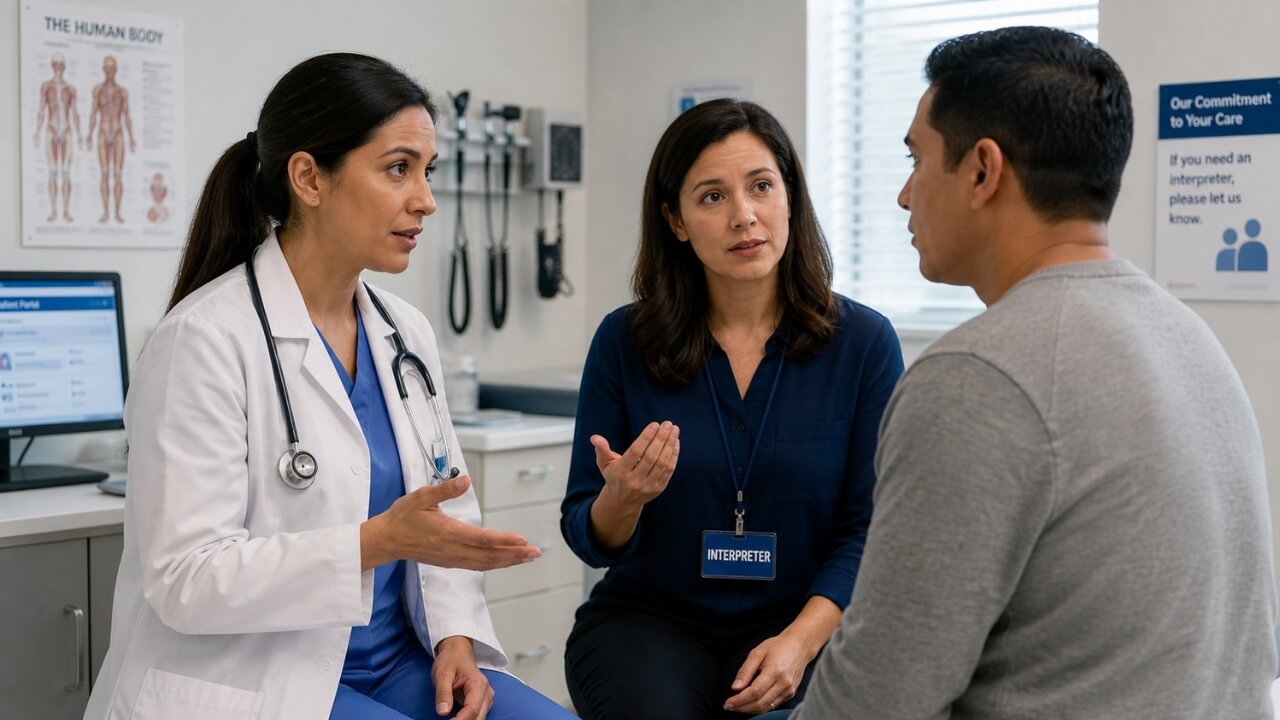
It applies wherever a language barrier stands between an individual and a public service. The settings below represent the most common and highest-stakes environments.
Healthcare
Medical community interpreting covers doctor-patient consultations, specialist referrals, informed consent discussions, mental health intake interviews, and emergency care. Errors in these settings cause direct harm. An interpreter working in healthcare must know medical terminology and maintain strict impartiality, conveying the full meaning of what each party says without softening, summarizing, or editorializing.
Our healthcare translation and interpreting services cover both real-time interpretation and written medical document translation across clinical environments.
Legal and Court Proceedings
Legal community interpreting spans police interviews, attorney-client consultations, depositions, immigration hearings, and courtroom proceedings. Dialect-specific matching is critical here. A Spanish interpreter trained in one regional variety may use terminology that carries different meanings for a speaker from another region. State and federal certification requirements vary by jurisdiction, and our legal interpreting services match interpreters by setting, certification level, and dialect.
Government and Social Services
Federal agencies receiving federal funding are required under Title VI of the Civil Rights Act to provide meaningful language access to LEP individuals. This covers:
- Immigration and USCIS offices
- Housing authorities and public benefit agencies
- Tax and revenue offices
- DMV and licensing agencies
- Social security and welfare services
Our government contracting services are structured for federal, state, and municipal language access requirements, including HIPAA, ITAR, and DOJ compliance.
Education
IEP meetings, parent-teacher conferences, enrollment appointments, and disciplinary hearings require accurate interpretation when parents or guardians are not proficient in English. Misinterpreted information in an IEP meeting can affect a child’s educational placement and the legal protections they are entitled to under federal law. For schools and families navigating these critical moments, our academic translation services ensure nothing gets lost in translation where it matters most.
Refugee and Resettlement Services
Asylum interviews, resettlement agency intake, and benefits enrollment are among the most consequential settings for community interpreters. The individual may have experienced trauma, may be unfamiliar with institutional processes, and may speak a regional dialect that differs significantly from the standard variety of their language.
Social Work and Mental Health
Child welfare investigations, domestic violence support, and mental health evaluations require interpreters who can handle emotionally charged content with precision and impartiality. In these settings, a single mistranslated phrase can alter the outcome of a case.
Delivery Modes in Community Interpreting
How community interpreting is delivered matters as much as who delivers it. We offer three formats, and the right choice depends on the setting, urgency, and the nature of the interaction.
In-person (onsite) is the preferred mode for high-stakes or emotionally sensitive situations where non-verbal communication, tone, and body language carry meaning. Medical procedures, child welfare visits, and courtroom proceedings benefit most from physical presence. Our onsite interpretation services are available nationwide with 24 to 48 hours’ notice, with same-day emergency coverage for contracted clients.
Phone interpreting (OPI) connects you with a qualified interpreter in 30 to 45 seconds. It suits shorter interactions, urgent situations, and cases where in-person is not possible. Our phone interpreter services cover 150+ languages, 24 hours a day, including weekends and holidays.
Video remote interpreting (VRI) combines remote access with visual communication, capturing the facial expressions and body language that phone cannot convey. It is well suited for medical appointments, legal consultations, and sensitive interviews conducted through Zoom, Microsoft Teams, or Google Meet. Our video interpretation services are HIPAA compliant and require no additional app or equipment from the client.
What Skills and Qualifications Does a Community Interpreter Need?

Bilingual fluency is a starting point, not a credential. ISO 13611 identifies 16 professional competencies that community interpreters must demonstrate. In practice, the most critical are:
- Subject-matter knowledge – an interpreter in a healthcare setting must know medical terminology; one in a legal setting must understand courtroom procedure and legal concepts
- Cultural competence – certain phrases, indirect communication styles, and culturally loaded terms do not translate literally; a qualified interpreter recognizes when cultural adaptation is needed and when to flag that a concept has no direct equivalent
- Impartiality – community interpreters do not advocate for either party; they convey meaning accurately, including register, tone, and nuance
- Confidentiality – everything said in the session is bound by strict privacy obligations, particularly in HIPAA-covered medical and legal environments
The Risk of Non-Professional Interpreters
Using family members, bilingual staff, or volunteers carries serious consequences:
- Medical misinformation and missed diagnoses
- Legal inaccuracies that affect case outcomes
- Confidentiality breaches in protected settings
- Power imbalances, particularly when children interpret for parents
Children interpreting for parents in medical or legal settings is both ethically problematic and, in many federally funded programs, legally impermissible. Professional certification exists precisely to eliminate these risks.
Our interpreters are certified and subject-matter matched to the environments they serve.
Community Interpreting vs. Medical Interpreting vs. Legal Interpreting
The relationship between these terms causes regular confusion, even among organizations that regularly need interpreting services.
Community interpreting is the broad category. It covers the full spectrum of public service settings: education, housing, social services, government agencies, and more.
Medical interpreting is a specialization within community interpreting, focused exclusively on healthcare environments. It carries domain-specific terminology requirements and, in some states, dedicated certification standards.
Legal interpreting focuses on judicial and legal proceedings. It overlaps with community interpreting in police and immigration settings, but courtroom interpreting in particular carries strict state and federal credentialing requirements.
Community Interpreting and Sign Language
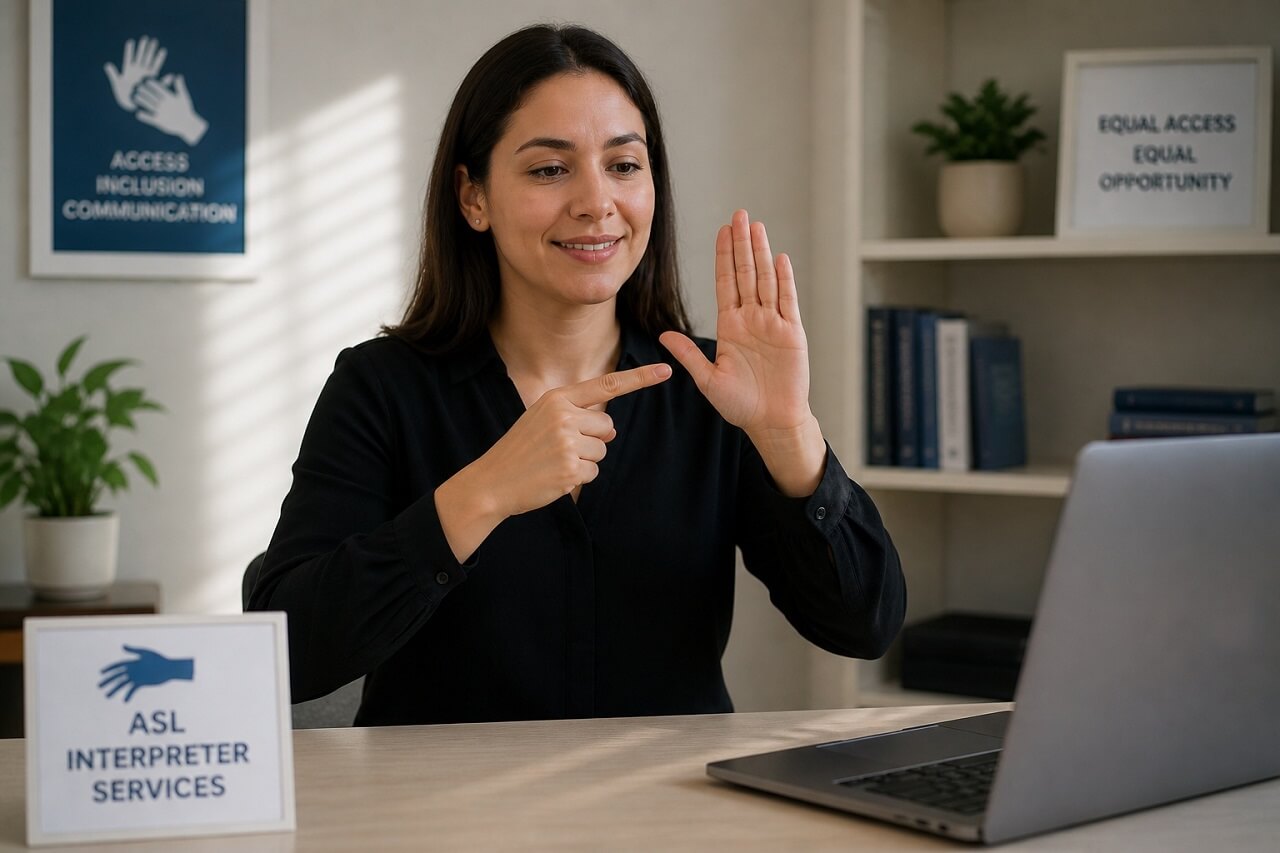
ADA compliance makes this a legal requirement for many organizations, not an optional accommodation. In complex communication situations, a Certified Deaf Interpreter (CDI) may be required alongside a hearing ASL interpreter to ensure full accuracy for individuals who use non-standard sign systems or have limited sign language exposure.
We provide nationally certified sign language interpreter services for in-person and remote assignments across healthcare, legal, educational, and corporate environments, including CDI availability on request.
How to Access The Services
Choosing a community interpreting provider requires more than finding someone who speaks the language. Four criteria determine whether the service will hold up in a regulated or high-stakes environment:
- Certification matched to the setting – medical, legal, or general community interpreting each carry different credential requirements
- Dialect-specific matching – for languages with significant regional variation, dialect matching is not optional
- Delivery mode flexibility – the provider should offer onsite, phone, and video so the format fits the session
- Compliance – for healthcare and legal settings, HIPAA compliance, ADA compliance, and Title VI language access requirements all apply
Organizations participating in federal programs should verify that their provider meets Title VI obligations. Organizations serving Deaf or Hard-of-Hearing individuals should confirm both ADA compliance and CDI availability.