

Try explaining the German word “Schadenfreude” in English. It refers to the feeling of pleasure someone gets from another person’s misfortune, yet there is no single English word that fully captures the same meaning.
These kinds of language gaps reveal the real difficulties translators deal with every day. Understanding why these problems exist is essential for building strong and effective cross cultural communication.
Cultural Nuances and Contextual Meanings

Cultural details and context play a major role in why translation can be so challenging. Many words and expressions are closely tied to a culture’s traditions, values, and social habits, which makes it hard to translate them accurately into another language.
A good example is the Japanese concept “wabi-sabi”. It reflects a way of seeing the world that embraces imperfection and the temporary nature of things, and there is no direct English word that fully expresses this idea. To translate it well, the translator has to understand the cultural background behind it, not just the dictionary definition.
Idioms create similar problems. Take the English phrase “raining cats and dogs”, which simply means very heavy rain. Most languages do not have an equivalent expression, so the translator must either find a culturally appropriate alternative or rephrase the sentence to preserve the original meaning.
At Elmura Linguistics, we assign each project to specialists who are deeply familiar with the subject area and the cultural context involved, ensuring that the message stays accurate and natural in every language.
Unique Concepts Without Direct Equivalents
Some words are hard to translate because they describe ideas or feelings that simply do not exist in the same way in other languages. The Portuguese word “saudade” is a good example. It expresses a deep emotional sense of longing and nostalgia for someone or something that is no longer present, and it doesn’t have a single-word counterpart in English.
The same applies to the German word “Fernweh”, which captures a powerful urge to travel far away and explore distant places. English has no single word that carries this full meaning. These examples show why certain words are so difficult to translate: they carry emotions and concepts that are deeply rooted in a specific culture.
Regional Dialects

Regional dialects create real challenges in translation because the same word can carry very different meanings depending on the country, or even the specific region within that country.
For instance, in Haitian Creole, the word machin usually means “car,” but in some rural communities it can also refer to a “machine” or an “engine.” In Spanish, guagua means “bus” in Cuba and the Dominican Republic, while in Chile it refers to a “baby.”
Russian offers another example: пирог (pirog) is generally translated as “pie,” yet in certain regions it describes a particular baked dish that is closer to bread or pastry. In Portuguese, rapariga simply means “girl” in Portugal, but in Brazil it is considered offensive slang.
These differences show why direct translation is often unreliable. The true meaning of a word depends heavily on cultural and regional context, not just on what a dictionary says.
Idiomatic Expressions and Colloquialisms
Idiomatic expressions and colloquialisms are phrases whose meanings cannot be understood just by looking at the individual words. Take the English phrase “break the ice” for example. It means to start a conversation or ease social tension, not to physically crack a piece of ice.
Translating expressions like these is difficult because their meanings are strongly tied to culture. Many idioms simply do not have direct equivalents in other languages, so a literal translation often causes confusion. For instance, the French phrase “appeler un chat un chat”, which literally means “call a cat a cat,” is used to describe speaking honestly and directly.
Because of this, translators must either find a similar expression in the target language or rewrite the idea in a way that keeps the original meaning. Doing this well requires a strong understanding of both cultures so that the message remains accurate and natural.
Words with Multiple Meanings
| English Word | Translations (Haitian Creole / Russian / Spanish / Portuguese) | Explanation |
|---|---|---|
| Bat | Mouch anmareng / Летучая мышь / Murciélago / Morcego | 1. A flying nocturnal mammal. 2. A club used in sports like baseball. |
| Light | Limyè / Свет / Luz / Luz | 1. A source of illumination. 2. Not heavy. 3. Not serious. |
| Bank | Bank / Банк / Banco / Banco | 1. A financial institution. 2. The side of a river. |
| Rock | Wòch / Камень / Roca / Rocha | 1. A solid mineral material. 2. A genre of music. 3. To move back and forth. |
| Tie | Kravat / Галстук / Corbata / Gravata | 1. A piece of clothing worn around the neck. 2. To fasten something. 3. A situation where two competitors have the same score. |
| Run | Kouri / Бежать / Correr / Correr | 1. To move quickly on foot. 2. To manage or operate something (e.g., a business). 3. A tear in fabric (e.g., in stockings). |
| Right | Dwa / Право / Derecho / Direito | 1. Correct or true. 2. The opposite of left. 3. A legal entitlement. |
| Spring | Prentan / Весна / Primavera / Primavera | 1. A season of the year. 2. A natural source of water. 3. A coiled metal object. |
| Wave | Vag / Волна / Ola / Onda | 1. A movement of water. 2. A hand gesture. 3. A type of energy transfer. |
| Watch | Mont / Часы / Reloj / Relógio | 1. A timepiece worn on the wrist. 2. To observe something. |
Words that carry multiple meanings, a concept known as polysemy, create serious challenges in translation. The same word can mean very different things depending on the situation, which makes it harder to deliver the correct message in another language.
A simple example is the English word “bank.” It can describe a financial institution, the edge of a river, or even a place where something is stored. Choosing the right translation depends entirely on understanding the context in which the word appears.
What makes translation especially difficult in these cases is the need to carefully analyze everything around the word before deciding on its meaning. Without that context, even an experienced translator can select the wrong interpretation, leading to confusion or a distorted message. This is one of the main reasons why certain words are so difficult to translate.
With more than 20 years of experience, our team at Elmura Linguistics is skilled at handling exactly these types of challenges. Our certified translators ensure that words with multiple meanings are interpreted accurately while preserving the intent of the original message. Through telephone, video, on-site, and written translation services in over 200 languages, Elmura Linguistics offers comprehensive solutions to meet diverse translation needs.
Compound Words and Language Structure
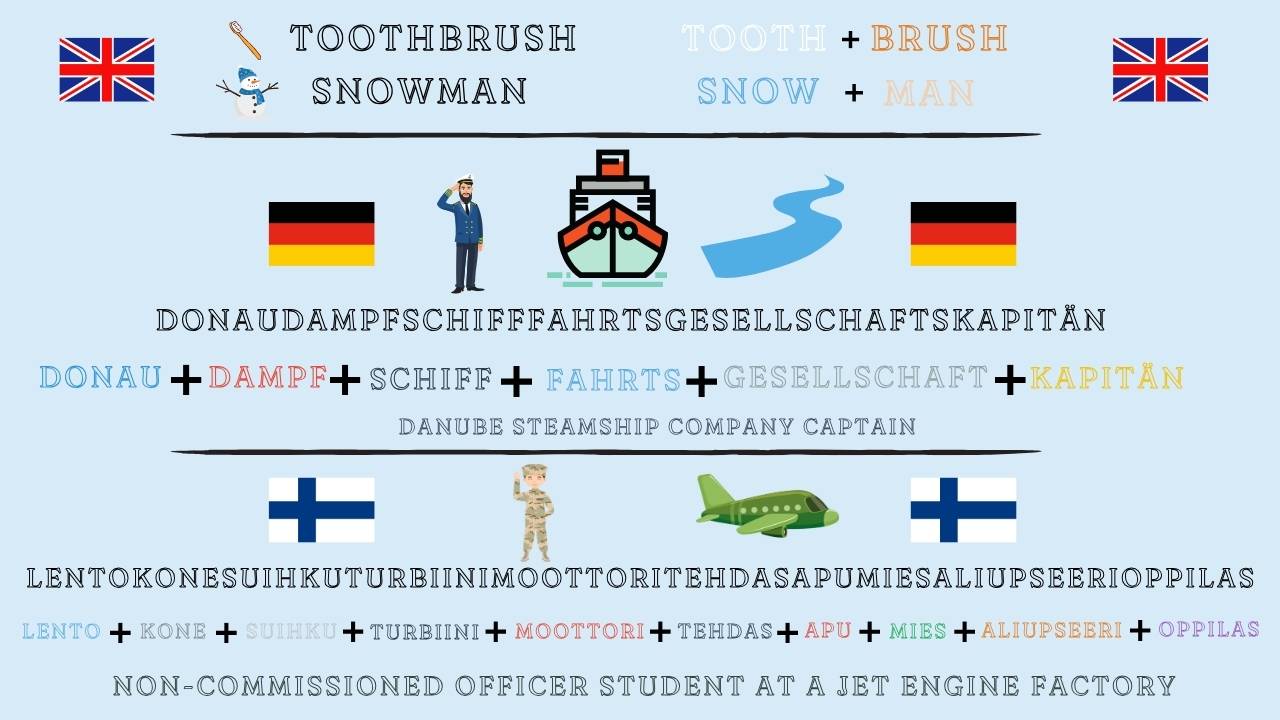
Compound words, which are created by joining two or more words together, can be especially challenging to translate because languages do not all follow the same structural patterns. In English, compounds like “toothbrush” or “snowman” are easy to understand, but other languages may not use this type of structure in the same way, particularly when dealing with long compound words.
German is a well known example. It often builds extremely long compounds such as “Donaudampfschifffahrtsgesellschaftskapitän,” which means “Danube steamship company captain.” When translating these into languages that do not support similar word formations, the result is often a long descriptive phrase, and sometimes parts of the original meaning become harder to preserve.
The challenge increases when the meaning of a compound goes beyond the literal meaning of its parts. The word “blackboard,” for example, does not simply mean a board that is black but refers to a classroom teaching tool. Translators must understand how such words are actually used in real life, not just how they are constructed.
In languages like Finnish, this issue becomes even more complex. A word such as “lentokonesuihkuturbiinimoottoritehdasapumiesaliupseerioppilas” describes a non commissioned officer student at a jet engine factory. Translating a term like this into English requires a long explanation, which clearly shows how difficult it can be to transfer the exact meaning from one language to another.
Conclusion
Idiomatic expressions, compound words, and words with multiple meanings often do not have direct equivalents in other languages, which makes precise translation especially difficult.
To communicate the real meaning, a translator must understand not only the languages themselves but also the cultural and situational context behind them.
A good example is the German word “Schadenfreude,” which describes the feeling of pleasure at someone else’s misfortune. Translating it requires far more than replacing words. It requires understanding how that idea is viewed and used within the culture in order to communicate it properly.
Overall, differences in language structure, cultural background, and the unique nature of certain words and expressions are what make translation such a complex and demanding process.