

French holds official status on five continents. You can follow it from a Swiss canton to a Caribbean island, a Pacific archipelago and the banks of the Congo River. We list every French speaking country and territory behind that route below.
26 Countries and 31 Territories Recognize French as an Official Language
French is an official language in 26 sovereign countries and in 31 territories and regions that are not sovereign states. The best-known French speaking countries are France, Canada, Belgium, Switzerland, Luxembourg and Monaco.
The largest African francophone countries by population are the Democratic Republic of the Congo, Cameroon, Côte d’Ivoire and Madagascar, and the DR Congo has the biggest population of all 26 sovereign countries, with more than 100 million people.
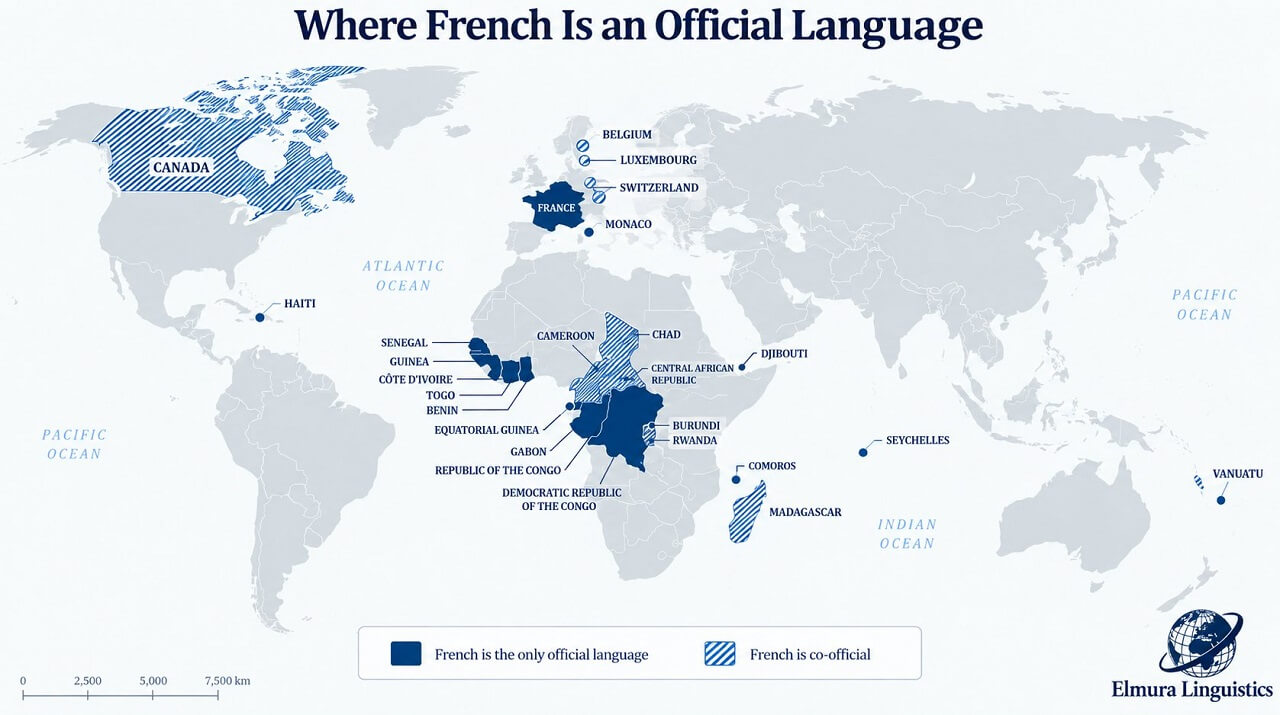
The countries that speak French officially are spread across Europe, Africa, North America and Oceania. French is the only official language in 10 of them and shares official status with other languages in the remaining 16. France’s overseas territories add South America, the Indian Ocean and the Antarctic region to the map. Here is the full list of French speaking countries by region:
| Region | French is the only official language | French is co-official (partner languages) |
|---|---|---|
| Europe | France, Monaco | Belgium (Dutch, German), Luxembourg (Luxembourgish, German), Switzerland (German, Italian, Romansh) |
| Africa | Benin, DR Congo, Republic of the Congo, Côte d’Ivoire, Gabon, Guinea, Senegal, Togo | Burundi (Kirundi, English), Cameroon (English), Central African Republic (Sango), Chad (Arabic), Comoros (Comorian, Arabic), Djibouti (Arabic), Equatorial Guinea (Spanish, Portuguese), Madagascar (Malagasy), Rwanda (Kinyarwanda, English, Swahili), Seychelles (Seychellois Creole, English) |
| North America | None | Canada (English), Haiti (Haitian Creole) |
| Oceania | None | Vanuatu (Bislama, English) |
Older lists show 29 countries. Those lists still include Mali, Burkina Faso and Niger, which moved French to working-language status between 2023 and 2025.
Beyond the sovereign states, French is official in 31 territories and regions. The five overseas departments of France, Guadeloupe, Martinique, French Guiana, Réunion and Mayotte, are legally part of France itself.
| Belongs to | French is the only official language | French is co-official (partner languages) |
|---|---|---|
| France, overseas departments | Guadeloupe, Martinique, French Guiana, Réunion, Mayotte | None |
| France, overseas collectivities and other territories | French Polynesia, New Caledonia, Wallis and Futuna, Saint Martin, Saint Barthélemy, Saint Pierre and Miquelon, French Southern and Antarctic Lands, Clipperton Island | None |
| Canada | Québec | New Brunswick (English), Yukon (English), Northwest Territories (English and Indigenous languages), Nunavut (Inuktitut, Inuinnaqtun, English) |
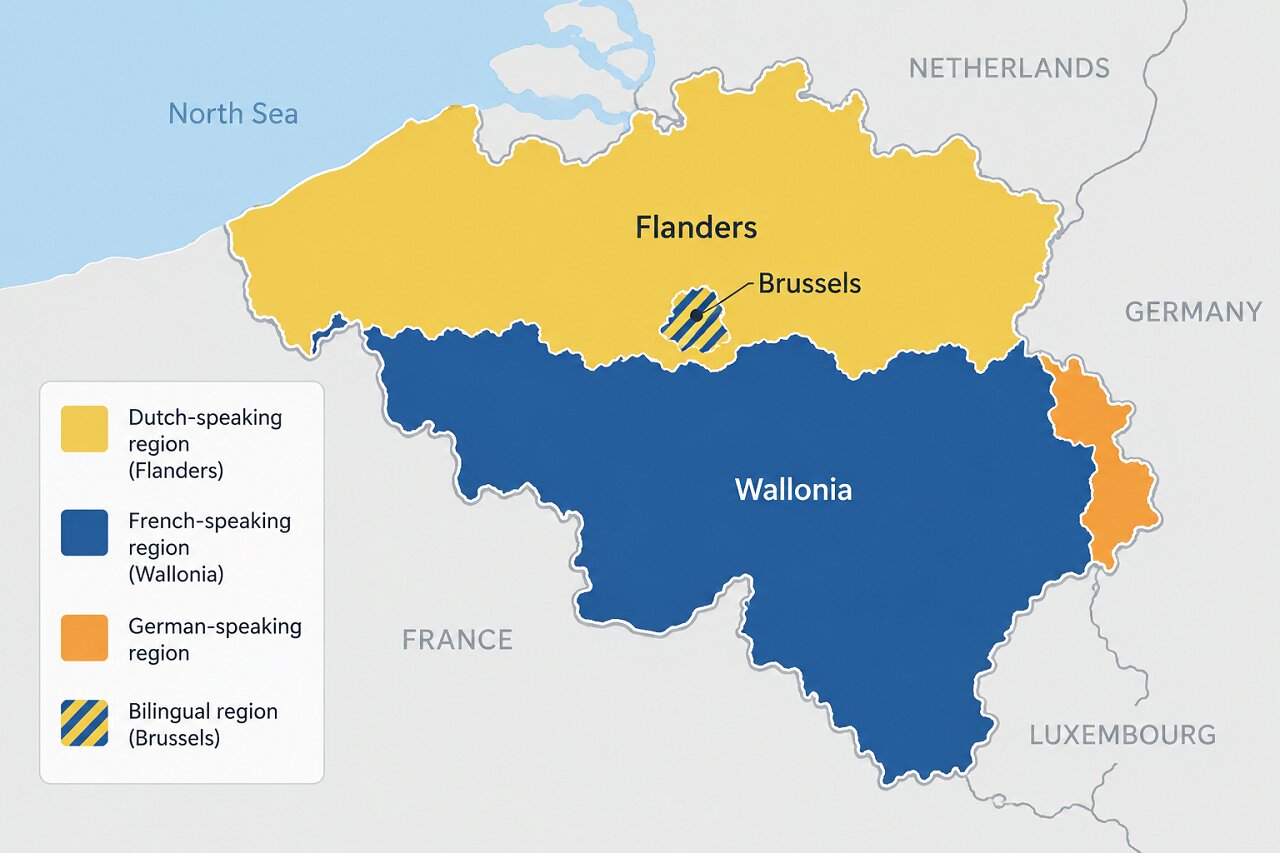
| Belgium | French Community | Brussels (Dutch), Wallonia (German) |
| Switzerland | Geneva, Jura, Neuchâtel, Vaud | Bern, Fribourg, Valais (all with German) |
| Italy | None | Aosta Valley (Italian) |
| India | None | Puducherry (Tamil, Malayalam, Telugu, English) |
| United Kingdom | None | Sark (English) |
Countries Where French Is Widely Used Without Official Status
Beyond the 26 official francophone countries, other countries that speak French every day have no official status for it. In the places below it still appears in universities, courts, media and commerce.
- North and West Africa: Algeria, Morocco, Tunisia and Mauritania use French daily in business, higher education and administration alongside Arabic.
- The Sahel: Mali, Burkina Faso and Niger keep French as a working language in schools, government offices and business.
- The Middle East: Lebanon gives French a defined legal role next to Arabic, its official language, and French remains common in its schools and professions.
- The Indian Ocean: Mauritius uses French widely in the press, business and daily life.
- Southeast Asia: Vietnam, Laos and Cambodia retain French in legal, diplomatic and academic settings after the colonial period.
- The United States: Louisiana and Maine permit French in some state services, schools and commerce, and neither state makes it official.
Contracts, court filings and school records from these countries are still written in French, and our document translation service works from the original text.
Where French Speakers Live Today
The Organisation internationale de la Francophonie (OIF) published its latest count in March 2026: 396 million French speakers, up from 321 million in 2022. That places French fourth among the most spoken languages in the world, behind English, Mandarin and Spanish.
Africa hosts 18 of the 26 French speaking countries with official status, and about 65 percent of all speakers live on the continent. The OIF projects around 590 million speakers by 2050, with nine in ten of them in Africa.
How French Differs From Region to Region
A French text carries its region in its vocabulary, its conventions and its level of formality.
- France: sets the reference for the formal written French used in most official documents.
- Belgium and Switzerland: speakers say septante and nonante for 70 and 90, and several Swiss cantons say huitante for 80.
- Québec: uses courriel for email and magasinage for shopping. The Charter of the French Language governs the use of French in commerce and at work, and any localization services project for that market has to reflect it.
- West and Central Africa: the countries that speak French there each add local vocabulary and rhythm. Côte d’Ivoire, for example, has Nouchi, a youth slang that blends French with local languages.
- Haiti: most people speak Haitian Creole day to day, and French is used in many formal and legal contexts, so Haitian Creole translation often travels alongside the French.
Readers in each region spot a mismatch on the first line, and listeners catch it just as fast in a hearing, which is why regional background counts in legal interpreting too.
How We Support French Projects
Elmura Linguistics has served clients since 1998, and French is among the languages our linguists handle. These are the services we most often connect to French, whichever of the French speaking countries a project targets:
- Certified French translation: French to English and English to French, with a signed certification statement for immigration filings, courts, universities and government agencies. See our French translation services.
- Industry translation: financial, healthcare, pharmaceutical, technical and marketing content, with terminology checked for each field.
- Interpreting: phone, video and onsite interpreters, including legal interpreting for attorneys and courts.
- Localization: adapting websites, software and marketing materials to a target market such as Québec, Belgium or West Africa.
Our interpreters and translators are available 24/7. Send us the country, the document type and the deadline, and we will scope the project.
Frequently Asked Questions
French has official status in 26 countries and 31 territories and regions, and daily use in many more places. Across the French speaking countries, the variety your reader expects depends on where they live. Tell us where your audience or document comes from, and we will match the project to the right linguist. Request a quote and we will get started.Talk to Us About Your French Project