

Chinese is not one language. It is a family of languages, and understanding that distinction matters whether you are learning the language, doing business in China, or commissioning a translation.
How Many Types of Chinese Language Are There?

Linguists recognize seven to ten major language groups within what is collectively called Chinese, depending on how certain transitional varieties are classified.
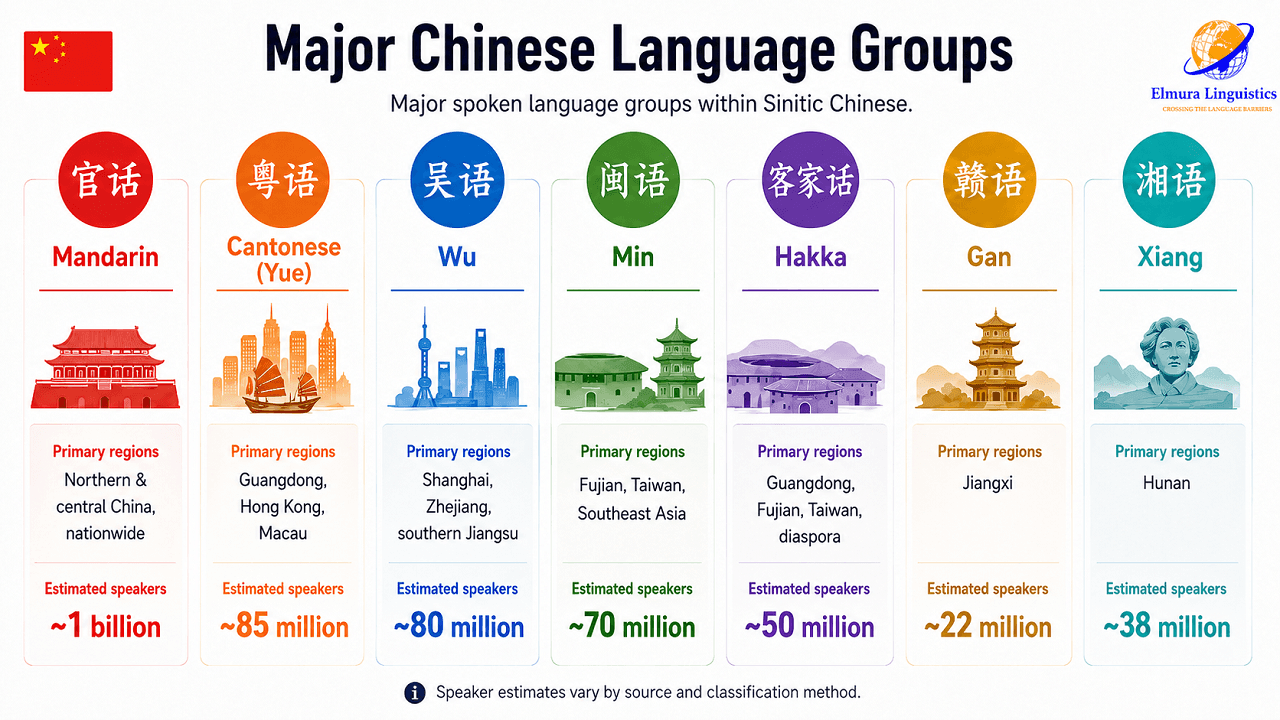
The standard framework, established in the Language Atlas of China and widely used by linguists today, identifies seven primary groups: Mandarin, Cantonese (Yue), Wu, Min, Hakka, Gan, and Xiang. Some classifications add Jin, Huizhou, and Pinghua as separate groups, bringing the count to ten.
Each of these groups contains multiple regional varieties, many of which are mutually unintelligible. A Mandarin speaker from Beijing and a Cantonese speaker from Hong Kong cannot follow each other’s speech without prior exposure.
“Dialects” or Separate Languages?
By the standard linguistic test of mutual intelligibility, these are distinct languages, not dialects. The Chinese term used for them, 方言 (fāngyán), is often translated as “dialect,” but that translation understates the degree of difference involved.
What unifies all of these spoken varieties is the writing system. Chinese characters (汉字, hànzì) are logographic rather than phonetic, so a character conveys meaning regardless of how a speaker pronounces it. A Cantonese reader and a Mandarin reader can process the same written text even when they cannot understand each other’s speech.
The Seven Major Chinese Language Groups
The table below summarizes the seven groups most widely recognized in academic and professional linguistic literature. Speaker estimates vary by source and methodology, but the figures below reflect current consensus ranges.
| Group | Chinese | Primary Regions | Estimated Speakers |
| Mandarin | 官话 Guānhuà | Northern & central China, nationwide | ~1 billion |
| Cantonese (Yue) | 粤语 Yuèyǔ | Guangdong, Hong Kong, Macau | ~85 million |
| Wu | 吴语 Wúyǔ | Shanghai, Zhejiang, southern Jiangsu | ~80 million |
| Min | 闽语 Mǐnyǔ | Fujian, Taiwan, Southeast Asia | ~70 million |
| Hakka | 客家话 Kèjiāhuà | Guangdong, Fujian, Taiwan, diaspora | ~50 million |
| Gan | 赣语 Gànyǔ | Jiangxi | ~22 million |
| Xiang | 湘语 Xiāngyǔ | Hunan | ~38 million |
Mandarin
Mandarin (普通话, Pǔtōnghuà) is the official language of the People’s Republic of China, the language of education from primary school through university, and the medium of government and national media. With over one billion speakers, it is the most widely spoken language in the world by native speaker count.
Mandarin is not monolithic. It spans a vast dialect continuum across northern and central China, with the Beijing pronunciation serving as the phonological standard for modern Pǔtōnghuà. A speaker from Chengdu or Xi’an carries a noticeably different accent, and Southwestern Mandarin varieties can sound quite distinct from the northern standard. What most people outside China call “Mandarin” refers specifically to this standardized form.
For translation purposes, Mandarin is written in Simplified Chinese characters in mainland China and Singapore, and in Traditional Chinese characters in Taiwan.

Cantonese
Cantonese (粤语, Yuèyǔ) is the primary spoken language of Guangdong province, Hong Kong, and Macau. It is also the ancestral language of the majority of overseas Chinese communities in North America, Australia, and the United Kingdom, which gives it a cultural footprint far larger than its speaker count alone suggests.
The phonological gap between Cantonese and Mandarin is significant. Cantonese has six to nine tones depending on the analytical system used, compared to Mandarin’s four. It retains final consonant sounds (-p, -t, -k, -m) that disappeared from Mandarin centuries ago, and its vocabulary and grammar differ substantially. Cantonese is written in Traditional Chinese characters.
From a translation standpoint, specifying Cantonese versus Mandarin matters. A document translated into Simplified Mandarin Chinese is not interchangeable with a Cantonese translation for Hong Kong or diaspora audiences.
Wu
Wu (吴语, Wúyǔ) is spoken across Shanghai, Zhejiang province, and southern Jiangsu, with approximately 80 million speakers. Shanghainese is its most prominent variety and carries significant cultural prestige as the language of China’s financial capital.
Wu dialects are phonologically complex. Shanghainese has five tones plus a tone sandhi system so extensive that nearly every syllable in connected speech changes its tone based on context. To a Mandarin ear, Wu sounds completely foreign, with softer consonants and a flowing rhythm that contrasts sharply with northern speech.
Min
Min (闽语, Mǐnyǔ) is the most internally diverse of all Chinese language groups. Its varieties are so distinct that speakers of different Min languages frequently cannot understand each other without prior exposure. This degree of internal divergence reflects the isolated mountain geography of Fujian province, where communities developed independently over centuries.
Hokkien (Southern Min, or 闽南语 Mǐnnányǔ) is the best-known variety, spoken in southern Fujian, Taiwan, Malaysia, Singapore, Indonesia, and the Philippines. In Taiwan it is widely known as Taiwanese (台语, Táiyǔ). With around 50 million speakers, Hokkien is one of the most globally distributed Chinese language varieties. Linguists note that Min preserves archaic features of Middle Chinese lost in most other varieties.
Hakka
Hakka (客家话, Kèjiāhuà, meaning “guest family speech”) is defined by migration rather than geography. The Hakka people are descendants of northerners who moved south over multiple historical waves and then spread further into Southeast Asia and the global diaspora. Hakka communities exist across Guangdong, Fujian, Jiangxi, Taiwan, Malaysia, and Singapore.
The language has around 50 million speakers and shows relatively conservative phonological features. Notably, several major figures in modern Chinese history, including Sun Yat-sen and Deng Xiaoping, have Hakka heritage.
Gan and Xiang
Gan (赣语, Gànyǔ) and Xiang (湘语, Xiāngyǔ) are the two smaller major groups, spoken primarily in Jiangxi and Hunan provinces respectively. Both sit between northern Mandarin and the southern language groups geographically and linguistically, incorporating features from both directions. Speakers of these varieties typically find acquiring standard Mandarin more straightforward than speakers of Cantonese or Wu.
What This Means for Translation
The practical implication of China’s linguistic diversity is that “translate into Chinese” is not a complete brief. The right variety depends on your audience:
- Mainland China business or government documents: Simplified Mandarin Chinese
- Hong Kong legal, financial, or consumer content: Traditional Chinese, with Cantonese register awareness
- Taiwan: Traditional Chinese
- Singapore: Simplified Chinese, Mandarin standard
- Overseas Chinese communities in North America or Australia: Depends on community origin; historically Cantonese, increasingly Mandarin
Getting this wrong creates real communication gaps. A legal document rendered in the wrong script or register signals unfamiliarity with the audience, which undermines credibility before the content is even read.
At Elmura Linguistics, our Chinese translation services cover Mandarin and Cantonese across both Simplified and Traditional Chinese, handled by native-speaking translators with subject-matter expertise. Whether your project involves legal contracts, business communications, certified documents, or technical content, we match the translator to the specific Chinese variety your audience reads.
FAQ
Conclusion

Chinese is one of the world’s most linguistically diverse language families. Seven major groups, hundreds of regional varieties, and two writing systems mean that working with Chinese content requires more precision than most clients initially expect.
Knowing which variety your audience reads and speaks is the starting point. Getting the translation right from there requires human expertise, not approximation.