


Download the Fillable Language Access Plan Template (PDF)
Key Takeaways
- A language access plan is required for any organization receiving federal financial assistance under Title VI of the Civil Rights Act of 1964.
- The plan must cover five areas: needs assessment, interpreter services, vital document translation, LEP notification, and staff training.
- Interpreters must be qualified. Bilingual staff who have not been formally assessed and family members of individuals served do not meet the federal standard.
- Vital documents must be translated into any language spoken by 5% of your served population or 1,000 individuals, whichever is less.
- Executive Order 13166 was revoked by Executive Order 14224 on March 1, 2025. The Title VI obligation for all federal assistance recipients remains fully in effect.
This is a ready-to-use Language Access Plan (sometimes called an LEP compliance plan or language assistance policy template) template designed for organizations receiving federal financial assistance under Title VI of the Civil Rights Act of 1964.
Replace all [bracketed fields] with your organization’s information. This document includes structured sections, compliance guidance, and sample language to support implementation of a complete language access program.
How to Use This Template
- Replace all [bracketed placeholders] with your organization’s data
- Customize interpreter and translation providers
- Align with your federal funding requirements
- Review annually or when services change
- Keep a compliance record for audits
What Is a Language Access Plan?

A language access plan is a formal written document that defines how your organization serves people who have limited English proficiency. It covers which language services you provide, how staff access those services, how LEP individuals are notified, and how the plan is reviewed over time.
Any organization that receives federal financial assistance through grants, contracts, or program funding from agencies such as HHS, HUD, DOJ, or DOE must take reasonable steps to provide meaningful access under Title VI. That obligation has not changed.
Executive Order 13166 was revoked by Executive Order 14224 on March 1, 2025, and DOJ subsequently rescinded LEP guidance documents issued under it. The underlying Title VI requirement for all recipients of federal financial assistance remains in full effect.
Organizations should replace any references to EO 13166 in existing plans with direct citations to Title VI and consult legal counsel to confirm their plans reflect current standards.
Needs Assessment Using the Four-Factor Analysis
Guidance for implementation: A structured analysis of who you serve, how often, what is at stake, and what resources you have. This section drives every decision that follows.
Federal guidance calls for a four-factor analysis:
| Factor | What to Evaluate |
| Population size | The number or proportion of LEP individuals your program serves or is likely to encounter |
| Frequency of contact | How often LEP individuals interact with your services |
| Program importance | The significance of your services to LEP individuals’ lives |
| Resources and cost | The resources and realistic costs of providing language services |
Once you complete the analysis, map it to specific touchpoints inside your organization:
- Call center and phone intake
- Reception and check-in
- Written communications and paperwork
- Grievance and complaint filing
- Wayfinding and building signage
Each touchpoint may require a different service solution, and your plan should address each one separately.
Data sources: If your organization lacks internal demographic data, the U.S. Census Bureau publishes language tables at the national, state, and county level. These work as proxies for identifying which languages to prioritize.
Output of this section: A prioritized list of languages and contact points. This list is what you build every other section around.
Interpreter Services

Section guidance: Documentation of how your organization delivers spoken language access, including the service modalities used, providers, availability hours, and quality review processes.
Federal requirements are consistent across programs: interpreters must be qualified. That means trained, tested, and demonstrably proficient in both languages. Bilingual staff who have not been formally assessed do not meet this standard. Family members of individuals served do not meet this standard.
Document each service modality your organization uses:
| Modality | What to Specify |
| Over-the-phone interpreting (OPI) | Provider, languages covered, hours of availability |
| Video remote interpreting (VRI) | Provider, languages covered, equipment protocols |
| On-site interpretation | How interpreters are sourced, credentialed, and scheduled |
For each modality, describe how interpreter accuracy is reviewed and how often these processes are audited.
Why this matters in practice: Federal program reviewers conduct test interactions by phone, video, and in person to evaluate interpreter access. Organizations that cannot quickly connect a non-English-speaking individual to a qualified interpreter risk compliance findings and loss of funding. Documented protocols give staff clear guidance and give auditors a record to review.
View this post on Instagram
Real-World Implementation Example
For example, a mid-sized municipal health clinic serving a diverse urban population identified that approximately 12% of its patients were Limited English Proficient, with Spanish and Arabic being the most commonly encountered languages.
As a result, the clinic implemented 24/7 over-the-phone interpretation services, added video remote interpretation for clinical consultations, and ensured that all intake forms and consent documents were translated into both languages. Additionally, multilingual signage was installed in reception and waiting areas, and staff were trained to immediately connect patients with certified interpreters without relying on ad-hoc bilingual staff.
This approach significantly reduced appointment delays, improved patient understanding of medical instructions, and helped the organization maintain compliance during a federal audit review.
Translation Workflow for Vital Documents
Compliance note: Identification of which documents require translation, your language prioritization criteria, and the complete workflow from flagging to distribution.
Federal translation requirements define a specific category of documents that must be translated. These are called vital documents:
- Notices of free language assistance
- Applications, eligibility notices, and enrollment forms
- Intake forms with significant consequences for the individual
- Complaint and grievance forms, legal notices, and benefit letters
Language prioritization: A widely accepted benchmark is to translate vital documents into any language spoken by 5% of the population served, or 1,000 individuals, whichever is less. This threshold originated from DOJ LEP guidance and remains standard practice under Title VI.
View this post on Instagram
Your language assistance policy template for this section should document the complete translation workflow:
- Identification — How documents are flagged as vital and prioritized for translation
- Language selection — Which languages require translated versions and why
- Translation and review — How translated documents are reviewed for accuracy before distribution
- Access — Where translated documents are stored and how staff retrieve them
- Update cycle — How often documents are reviewed and revised as content changes
For any vital document that exists only in English and has not yet been translated, include taglines in the most common LEP languages directing individuals to available interpretation services.
Proactive Notification of Language Services
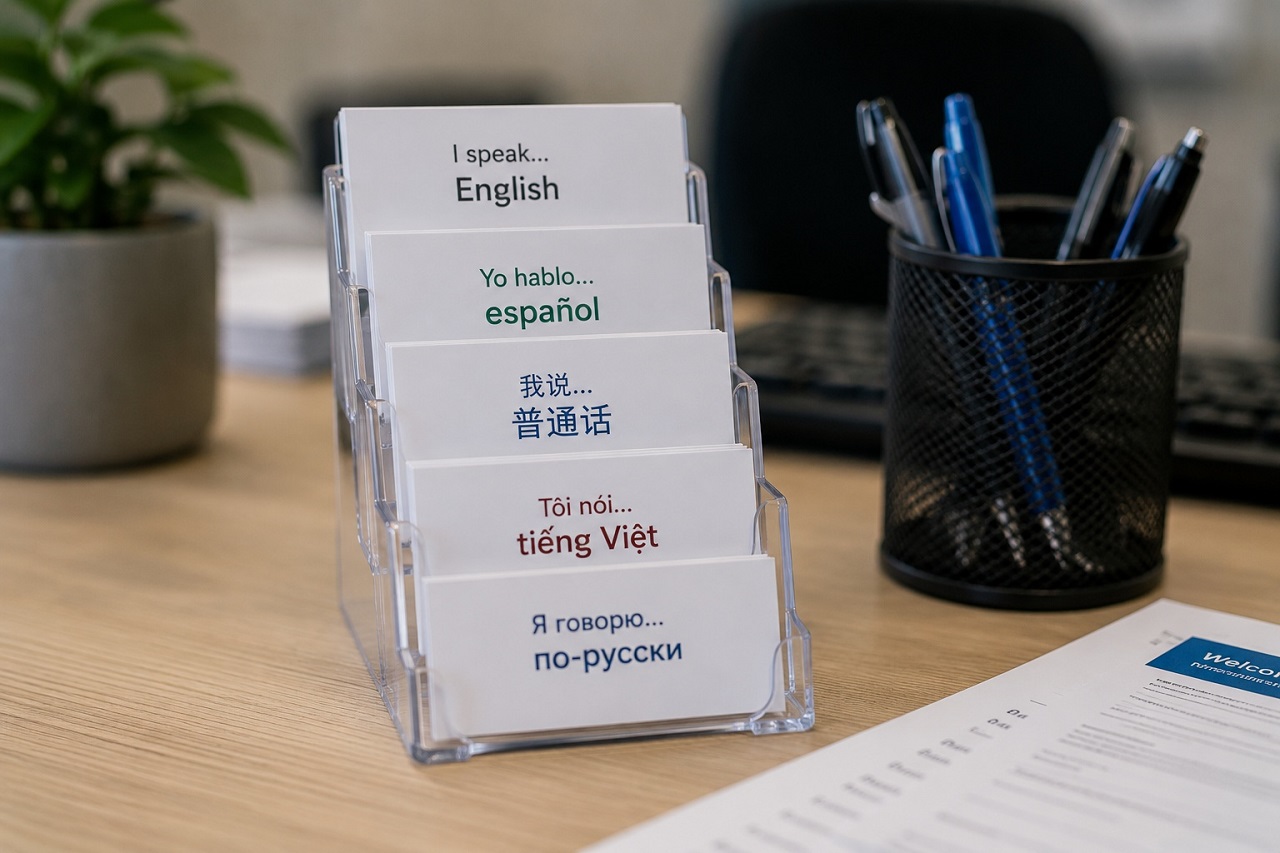
How to complete this section: A documented approach to informing LEP individuals that language services exist, before they are in a situation where they need to ask.
Federal guidance requires notification to be proactive, not reactive. Language services only work if the people who need them know about them in advance.
Document outreach across every channel your organization uses:
In-facility
- Taglines on vital documents
- “I speak” cards at reception desks and call center stations
- Multilingual signage at key points of contact
Digital
- Taglines on English-only web pages
- Client or member portal notifications
- Multilingual website options where feasible
Outreach
- Community partnerships with organizations serving LEP populations
- Non-English media channels
- Public service announcements targeting LEP communities
Designate a specific staff member or office responsible for keeping these notices current. If languages change, regulations are updated, or service offerings shift, someone needs to own that update process. That accountability ties directly into the coordinator role in the next section.
Staff Training and the Language Access Coordinator
Section guidance: Training requirements by staff level, a recurring training cadence, documentation procedures, and the designated Language Access Coordinator role.
Training without accountability produces inconsistent results. Federal guidance recommends designating a Language Access Coordinator to own and maintain the plan. Core responsibilities include:
- Overseeing the LEP compliance plan and maintaining compliance documentation
- Maintaining a database of qualified interpreters and translators
- Training staff on how to access and use language assistance services
- Coordinating and managing interpretation and translation requests
- Managing the language access budget
- Regularly assessing program performance and updating the plan
Training should operate at two levels:
| Audience | Training Focus |
| All staff | What services exist, how to access them, why using unqualified interpreters creates legal and programmatic risk |
| Frontline staff | How to work effectively with an interpreter, how to communicate respectfully with LEP individuals |
Training records function as audit evidence. Document who was trained, when, and on what. Set a recurring schedule at minimum annually, with additional sessions when services change, new staff join, or the plan is updated.
Keeping Your Plan Current
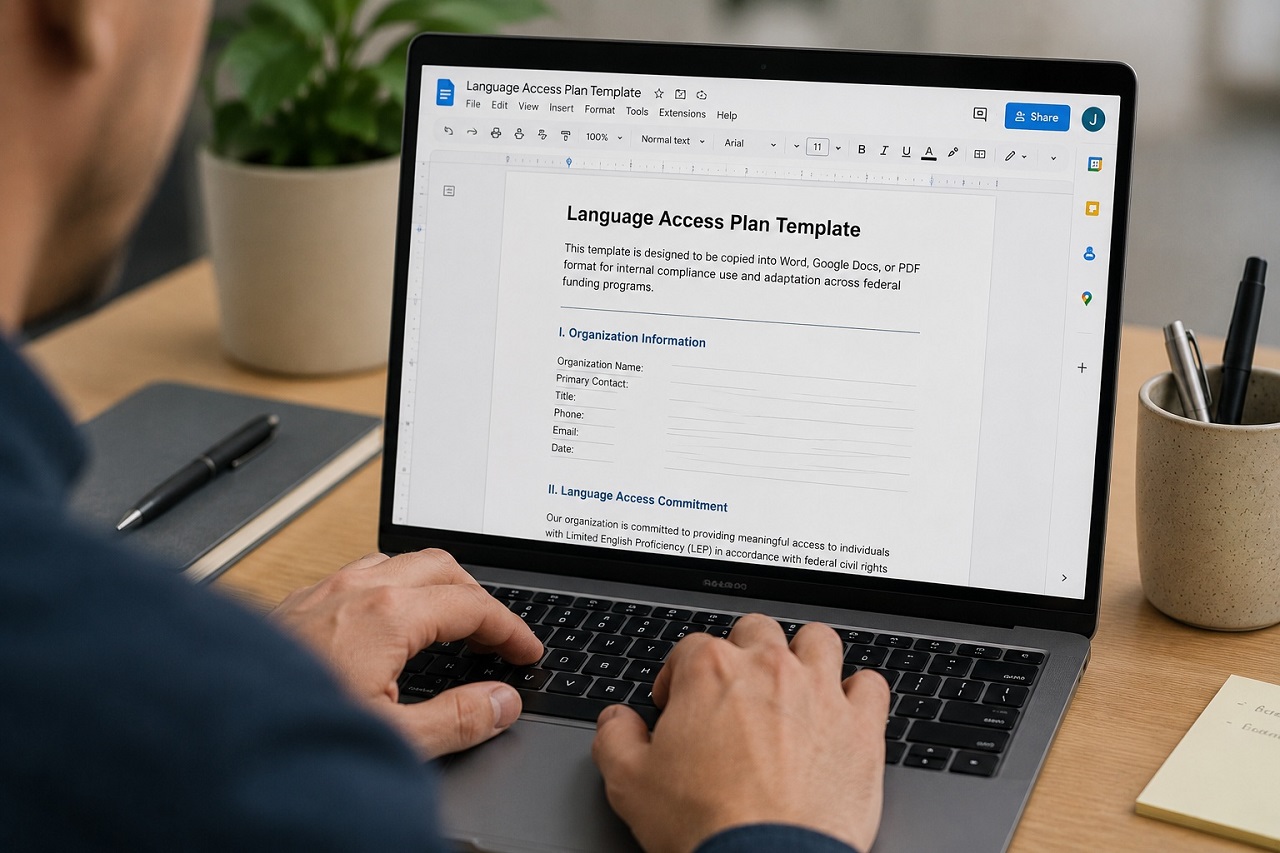
A language access plan is not a one-time filing. Federal guidance expects organizations to monitor service utilization, track complaints and grievances related to language access, and update the plan as community demographics and service offerings change.
Build an evaluation cycle into the plan from the start. Define specific metrics, such as interpreter request volume, complaint frequency, and document translation completion rates, and set a formal review schedule.
This template is designed to be copied into Word, Google Docs, or PDF format for internal compliance use and adaptation across federal funding programs.
LANGUAGE ACCESS PLAN – TEMPLATE (COPY & FILL)
Organization Information
- Organization Name: [Insert Organization Name]
- Programs Covered: [Insert Programs]
- Service Area: [City / Region / State]
- Date Adopted: [Insert Date]
- Review Cycle: [Annual / Biannual]
Purpose Statement
[Organization Name] is committed to ensuring meaningful access for individuals with Limited English Proficiency (LEP) in accordance with Title VI of the Civil Rights Act of 1964.
LEP Population Assessment
The organization serves LEP populations based on the following data:
- Primary languages: [Insert Languages]
- Estimated LEP population: [Insert % or number]
- Data sources: [Census / Intake data / Surveys]
Interpreter Services
Interpreter services are provided via:
- Over-the-phone interpretation (OPI): [Provider / Hours]
- Video remote interpretation (VRI): [Provider / Access method]
- On-site interpretation: [Process for scheduling]
Translation of Vital Documents
Vital documents include:
- Applications
- Consent forms
- Legal notices
- Complaint forms
- Eligibility documents
Languages for translation: [Insert Languages]
Proactive Notification
Language assistance is communicated via:
- Website taglines
- Multilingual signage
- Printed notices
- Community outreach
Staff Training & Coordinator
Language Access Coordinator: [Name / Title]
Responsibilities:
- Manage language services
- Oversee training
- Maintain compliance records
Training:
- Onboarding training required
- Annual refresher training
Work With Qualified Language Services Partners
We provide certified translation, qualified interpretation, and vital document workflow support for organizations operating under Title VI, HIPAA, and other federal compliance frameworks. If you are building or updating a language access plan and need support with translation or interpretation, contact us to discuss your organization’s needs.