

Asia is the most linguistically complex place on Earth. No other continent comes close to its combination of scale, diversity, and historical depth across language families.
For anyone working in translation, localization, or international communication, understanding Asia’s linguistic landscape is foundational knowledge.
Number of Languages Spoken in Asia
Over 2,300 languages are spoken across Asia, spanning more than a dozen major language families and several language isolates.
Asia is home to more than 5 billion people, which means it holds roughly two-thirds of the global population and nearly one-third of the world’s total languages.
The most spoken language on the continent is Mandarin Chinese, with over 1 billion native speakers.
Major Language Families of Asia
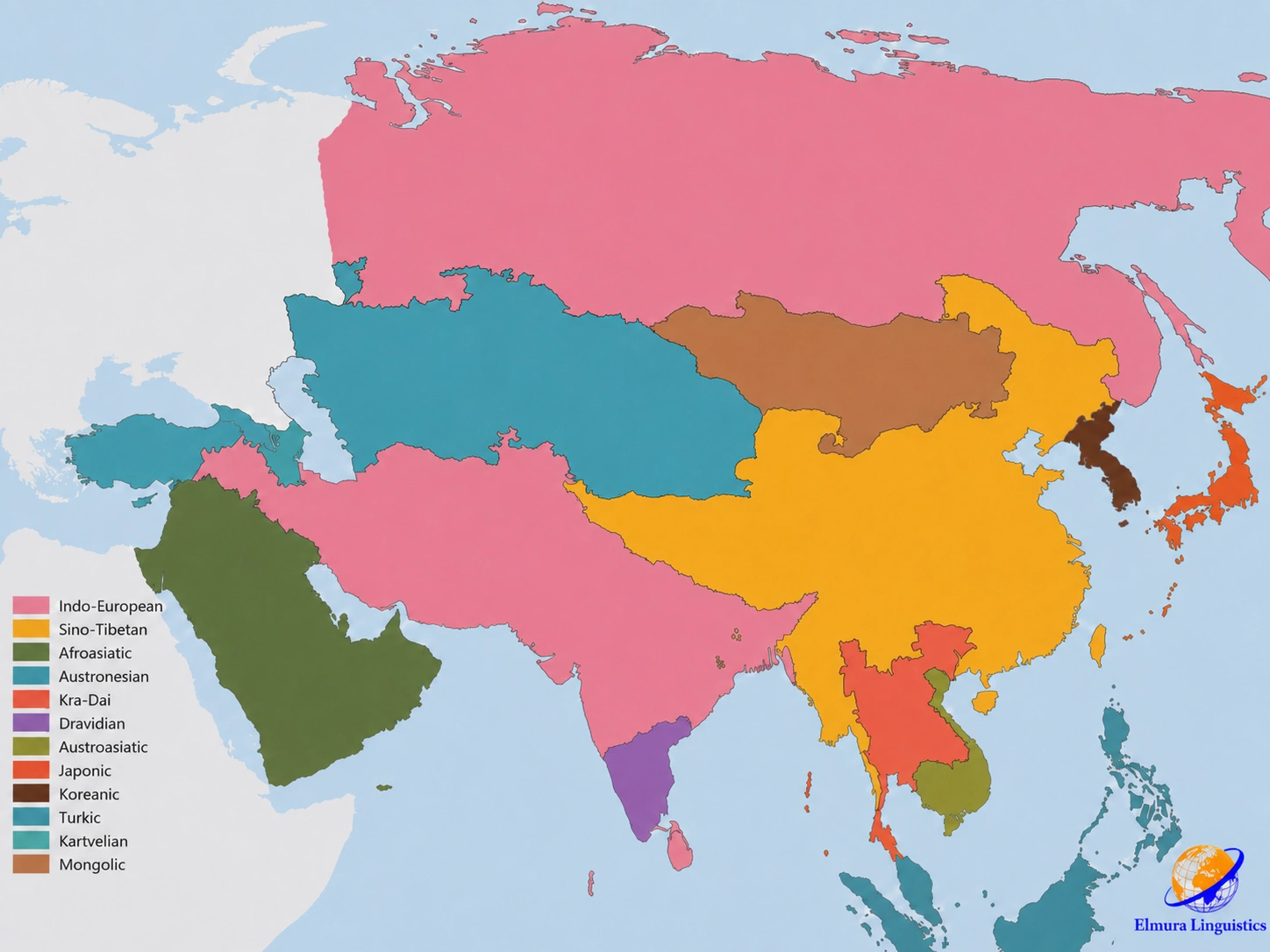
Asia’s languages do not descend from a single common source. They developed across geographically separate regions over thousands of years, which is why today’s Asian languages span radically different scripts, grammar systems, and phonologies.
- Sino-Tibetan is the dominant family of East Asia. It includes Mandarin Chinese, Cantonese, Tibetan, and Burmese, with a combined speaker count of approximately 1.5 billion. Most Sino-Tibetan languages are tonal, meaning pitch changes the meaning of a word entirely. They use logographic or syllabic writing systems rather than alphabets.
- Indo-European is the largest language family globally by total speakers. In Asia, it is represented primarily by the Indo-Iranian branch: Hindi, Bengali, Punjabi, Marathi, and Gujarati in South Asia, and Persian, Kurdish, and Pashto across the Iranian Plateau and surrounding countries.
- Dravidian languages are concentrated in southern India and Sri Lanka. Tamil, Telugu, Kannada, and Malayalam are its four major members. Tamil’s documented literary tradition stretches back over 2,000 years, making it one of the oldest continuously used literary languages in the world.
- Austronesian covers Maritime Southeast Asia. Indonesian, Malay, Tagalog, Javanese, and Cebuano all belong to this family. Indonesian alone is spoken by over 270 million people and functions as the national bridge language across one of the most linguistically fragmented nations on earth.
- Afroasiatic is represented in Asia through Arabic, the official language of 13 countries in Western Asia. Roughly 310 million Arabic speakers live in the Asian region.
- Turkic languages span Central Asia and parts of Western Asia. Turkish, Uzbek, Kazakh, Azerbaijani, and Uyghur are the major members. These languages are agglutinative, building complex meanings by attaching suffixes to a root word. Scripts vary across the family, with different languages using Latin, Cyrillic, or Arabic script.
- Austroasiatic covers mainland Southeast Asia, with Vietnamese and Khmer (Cambodian) as its most prominent members.
- Kra-Dai (also called Tai-Kadai) includes Thai and Lao, both spoken across mainland Southeast Asia.
- Japanese and Korean stand outside all major families. Korean is classified as a language isolate with no demonstrated genetic relationship to any other language.
Japanese is closely related to the Ryukyuan languages of the Ryukyu Islands but otherwise unrelated to any neighboring family. Both present significant challenges in translation due to grammar structures that differ sharply from English and most European languages.
Most Spoken Languages in Asia
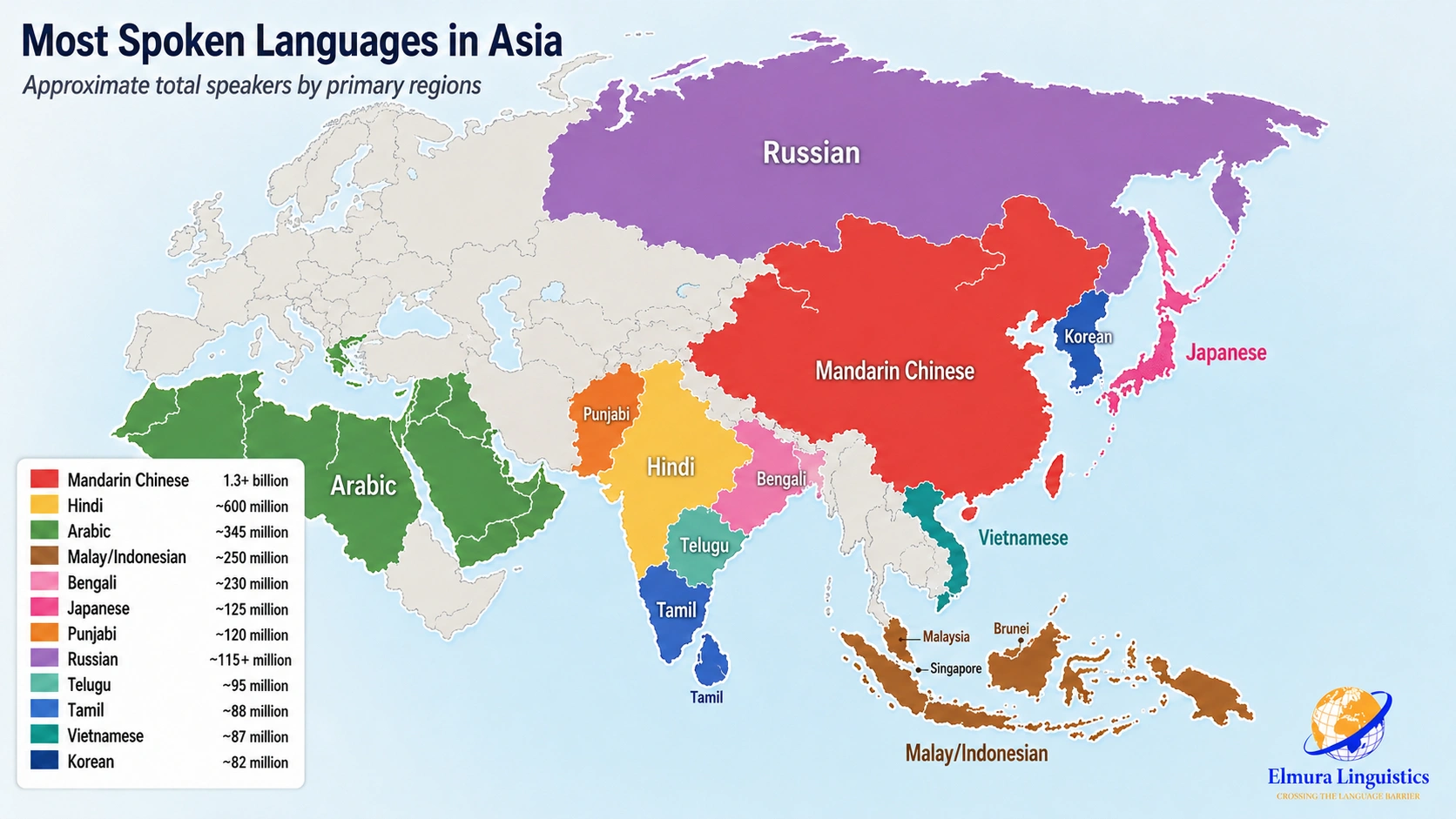
The table below covers the most widely spoken Asian languages by approximate total speakers.
| Language | Approx. Speakers | Primary Regions |
| Mandarin Chinese | 1.3+ billion | China, Taiwan, Singapore |
| Hindi | ~600 million | India, parts of South Asia |
| Arabic | ~345 million | Western Asia (Middle East) |
| Malay/Indonesian | ~250 million | Indonesia, Malaysia, Brunei, Singapore |
| Bengali | ~230 million | Bangladesh, India (West Bengal) |
| Russian | ~115+ million | Russia, Central Asia |
| Punjabi | ~120 million | India, Pakistan |
| Japanese | ~125 million | Japan |
| Telugu | ~95 million | India (Andhra Pradesh, Telangana) |
| Vietnamese | ~87 million | Vietnam and diaspora communities |
| Korean | ~82 million | South Korea, North Korea |
| Tamil | ~88 million | India, Sri Lanka, Malaysia |
A few languages on this list deserve a closer look from a translation standpoint.
Mandarin Chinese is the most spoken language in Asia and ranks first globally by native speaker count. Several other Chinese varieties coexist alongside it, including Cantonese (~85 million speakers), Wu (~82 million), and Min (~30 million).
These varieties are mutually unintelligible in spoken form. A document translated into Simplified Chinese Mandarin is not appropriate for Hong Kong audiences, who read Traditional Chinese and often speak Cantonese natively.
Arabic presents a similar challenge. Modern Standard Arabic (MSA) is used in formal writing and broadcasting across all 22 Arab League countries, but regional dialects can be mutually unintelligible across geographies.
Egyptian Arabic, Gulf Arabic, and Levantine Arabic each require different localization decisions. Elmura Linguistics’ document translation service covers both MSA and regional variants.
Japanese uses three writing systems simultaneously: kanji (logographic characters borrowed from Chinese), hiragana, and katakana. All three may appear in a single sentence.
This multi-script structure, combined with Japanese’s distinct grammatical registers for different levels of formality, makes it one of the most complex active languages for localization.
If your organization needs live communication support, Elmura’s onsite interpretation services and video interpretation services are available 24/7.
Country-Level Linguistic Diversity

Some of Asia’s most linguistically complex nations contain hundreds of languages within a single set of borders.
- Indonesia recognizes over 700 regional languages across its islands, making it the most linguistically diverse country in the world by number of distinct languages.
- India constitutionally recognizes 22 official languages and has hundreds of additional dialects. Hindi dominates in the north, while Dravidian languages prevail in the south.
- China has one official language (Mandarin), but roughly 300 distinct languages and dialects are spoken across the country, including Tibetan, Uyghur, Mongolian, and dozens of regional Sinitic varieties.
- Philippines recognizes over 170 regional languages, with Tagalog as the basis of Filipino, the national standardized language.
Endangered Languages in Asia
Linguistic diversity across Asia also means significant fragility. According to The Atlantic, nearly half of the world’s 3,054 endangered languages are Asian.
Languages at risk include Ainu in Japan, Saaroa in Taiwan, and Kusunda in Nepal. Urbanization and the dominance of national languages in education and government are the primary drivers of language attrition across the region.
What This Means for Translation

Asia’s scale creates both an opportunity and a practical requirement for organizations operating across borders. The Asia-Pacific region holds roughly 34% of the global language services market in 2026 and is its fastest-growing segment.
Several factors make Asian language translation particularly demanding in practice:
- Script systems. Non-Latin scripts require specialized handling, from right-to-left rendering for Arabic to vertical text options in Japanese, to the circular flowing script of Burmese.
- Tonal languages. Mandarin, Cantonese, Vietnamese, and Thai all use pitch to distinguish meaning. Errors in tonal translation are not minor. They produce words with entirely different meanings.
- Dialect divergence. The gap between Standard Arabic and Gulf or Egyptian dialect, or between Mandarin and Cantonese, is substantive, not stylistic. Localization targeting the wrong variety reaches the wrong audience.
- Register variation. Japanese has multiple grammatical registers for formal and informal address. Thai has five registers, including specialized vocabulary reserved for the royal family. Translators working without deep training in these systems produce content that fails quality review.
For legal interpreting or healthcare translation services involving Asian languages, these distinctions carry real consequences. Accuracy in regulated industries depends on linguists who specialize in the specific variety and register required.
Frequently Asked Questions
Conclusion
Asia holds more than 2,300 languages across at least ten major families, several isolates, and hundreds of endangered regional varieties. Mandarin Chinese, Hindi, Arabic, Indonesian, and Bengali rank among the most spoken, but the continent’s linguistic depth goes far beyond these headline numbers. Dialect variation, script complexity, and register distinctions mean that working with Asian languages requires specific expertise, not generic translation capacity.
If your organization needs translation or interpretation support in any Asian language, Elmura Linguistics works across 150+ languages with certified linguists available around the clock. Request a quote or explore the full list of languages we translate.