
Signing your marriage certificate took a few minutes. One missing line on its translation can slow your whole case down.
We see it often at Elmura Linguistics: a couple finishes every form, collects every piece of evidence, and then gets stuck on the one page written in another language.
The good news is that the rules are short. Once you know how to translate a marriage certificate for USCIS, this becomes one of the easier parts of your filing.
USCIS Marriage Certificate Translation Requirements
For a foreign-language marriage certificate submitted with Form I-130, your filing will generally include three pieces: a copy of the marriage certificate, a full English translation, and the translator’s certification. The rule sits in 8 CFR 103.2(b)(3), and the USCIS Form I-130 page repeats it for spouse petitions.
- A full English translation. The translation should account for all relevant text and markings on the document, including stamps, seals, handwritten notes, and marginal annotations. Illegible text should be identified rather than guessed.
- A translator’s certification. It states that the translation is complete and accurate, and that the translator is competent to translate from the source language into English.
- A copy of the certificate. Submit the translation together with a legible copy of the document it translates.
Marriage Certificate Translation Step by Step
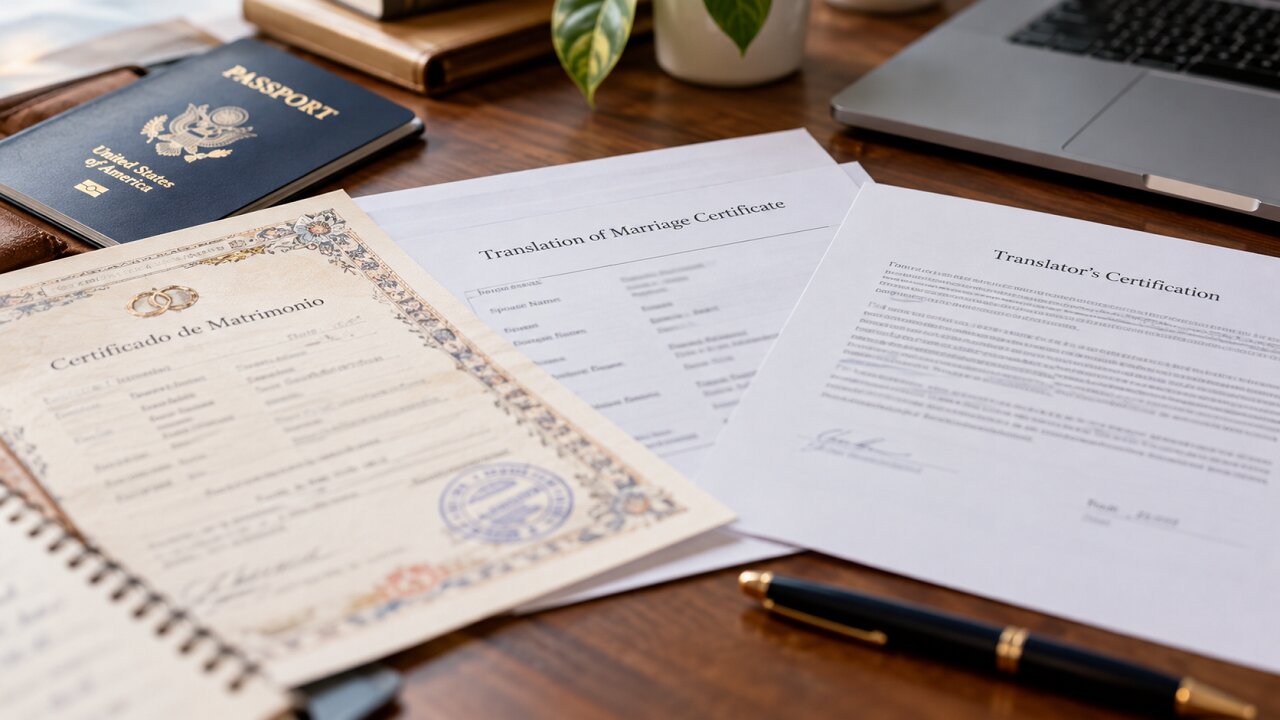
Here is how to translate a marriage certificate in four steps. Take them in order and you will avoid the usual delays.
Step 1: Get a clear copy of the certificate
Scan or photograph the whole page with all four corners visible. Include the back if it carries stamps or notes. Faded registry seals are common on older certificates, and our Spanish translation services team handles them daily. A sharp scan saves everyone guesswork.
Step 2: Decide who translates
USCIS rules do not require the translator to be a professional translation company or ATA-certified translator. The key requirement is that the translator certify that the translation is complete and accurate and that they are competent to translate from the source language into English. Using a professional translator can nevertheless reduce the risk of omissions, inconsistent names or dates, and an incomplete certification.
Step 3: Send the translator the right details
Share the passport spelling of both names so the translation matches the rest of your file. This is especially important when names are transliterated from a different writing system, such as Cyrillic, Arabic, or Chinese, because more than one English spelling may be possible. The translator should accurately reflect the original document while keeping established name spellings consistent with your immigration documents where appropriate.
Ask for dates written out, such as March 5, 2019, because 03/05/2019 can be interpreted differently in the US and in many other countries.
Step 4: Check the certification, then assemble the packet
Read the certification before you file. Keep the copy of the certificate, the full translation, and the signed certification together in your filing. If your case also needs a birth certificate, the same process applies, and our birth certificate translation services follow it.
What a Complete Certification Looks Like
USCIS does not publish an official template. The I-130 instructions list what the certification must contain: the translator’s signature, printed name, signature date, and contact information. Here is how that looks in practice.
| Element | What USCIS expects | Common slip |
|---|---|---|
| Accuracy statement | The translation is complete and accurate | Wording such as “approximate” or “summary” |
| Competence statement | The translator can translate from the source language into English | Left out entirely |
| Signature, printed name, date | All three on the certification | Unsigned or undated page |
| Contact information | Translator’s contact information | Contact information omitted |
| Translation body | A full English translation of the submitted foreign-language document | Omitting text, annotations, stamps, or information appearing elsewhere on the document |
Marriage Certificate Translation Mistakes That Can Cause USCIS Problems
An incomplete or improperly certified translation can lead USCIS to request additional evidence or prevent the document from receiving the evidentiary weight you intended. Either way, it can complicate or delay the case. That means extra waiting and extra stress, and it is easy to prevent.

These are the mistakes we correct most often:
- Names spelled differently from the passport
- Stamps, seals, or margin notes left untranslated
- A short summary in place of a full translation
- A certification without the competence line
- Dates that mix up day and month
- A translation attached to a different version of the certificate than the one submitted
When Professional Help Makes Sense
If you need a certified marriage certificate translation and want the certification handled correctly on the first try, that is where we come in.
Our translators are human, and every USCIS translation comes with a signed Certificate of Accuracy on letterhead with our ATA member ID. The translation arrives as a locked PDF, ready to upload. Turnaround is usually 24 to 72 hours, rush options are available, and revisions are free if USCIS asks for a correction.
Divorce decrees, prior marriage records, and other supporting papers can go through our document translation service. We work in dozens of languages, listed on our all languages we translate page.
Frequently Asked Questions
Does USCIS require a notarized translation?
No. USCIS asks for the translator’s certification described above. Some consulates and other agencies do ask for notarization, so check the rules of whoever receives your document.
Should I send my original certificate?
Send a legible copy unless USCIS specifically requests the original. It may ask for originals later, so keep yours in a safe place.
Does the translator need ATA certification?
No. USCIS does not require the translator to be ATA-certified. The translator must certify that the translation is complete and accurate and that they are competent to translate from the source language into English. Our translations are completed by human translators and come with a signed Certificate of Accuracy on letterhead, including our ATA member ID.
What happens if USCIS questions my translation?
If USCIS issues a Request for Evidence, the notice will state your response deadline. USCIS rules cap the RFE response period at 12 weeks, but the actual deadline on your notice may be shorter. Follow the date on the RFE rather than assuming you have the full 12 weeks. Send a corrected translation with a complete certification before that date.
Can I reuse the same translation for a second filing?
Usually yes, as long as it covers the same certificate and stays together with its signed certification. Read the instructions of the new form before you file.
Note: USCIS requirements and form instructions can change. Always check the instructions for the specific form you are filing. Translation services provide linguistic assistance and do not constitute legal advice.
Conclusion
Now you know how to translate a marriage certificate for USCIS: full English text, a signed certification, and a matching copy of the original. Check the details against the table above and file with confidence.
If you would like us to take it off your plate, you can request a quote and we will get started.